Idea Statica
  • Steel
  • Concrete
  • Support & Learning
  • Pricing
  • Company
  • Steel overview
  • Connection design
  • Member design
  • Parametric design
  • Steel case studies
  • Concrete overview
  • Walls and D-regions
  • Anchoring design
  • Concrete case studies
  • BIM Overview
  • Supported integrations
  • Checkbot
  • Viewer
  • APIs
  • Support Center
  • E-learning & certification
  • Blog
  • Downloads & Licensing
  • Plans
  • Free community tool
  • Enterprise customers
  • Students & educators
  • How much will you save?
  • About us
  • Contact
  • Research & development
  • Authorized resellers
  • Meet our customers
  • Career
  • Steel
    Steel overviewConnection designMember designParametric designSteel case studies
  • Concrete
    Concrete overviewWalls and D-regionsAnchoring designConcrete case studies
  • BIM OverviewSupported integrationsCheckbotViewerAPIs
  • Support & Learning
    Support CenterE-learning & certificationBlogDownloads & Licensing
  • Pricing
    PlansFree community toolEnterprise customersStudents & educatorsHow much will you save?
  • Company
    About usContactResearch & developmentAuthorized resellersMeet our customersCareer
14-Day Trial
14-Day Trial

Subscribe to our newsletter

Company

  • About us
  • Partners
  • Careers
  • Patent

Resources

  • Customer projects
  • Case studies
  • Connection Library
  • Verification books

Legal

  • EULA
  • Privacy policy
  • California Privacy
  • TOS Viewer
  • Licensing

Help

  • Contact
  • Quote request
  • Resellers
  • Downloads
FacebookInstagramLinkedInYouTube

ยฉ IDEA StatiCa 2009-2026

Trusted and used worldwide by engineers, fabricators & consultants.

Support CenterKnowledge Base ArticlesSmooth rebars in Detail
Reinforcement template in IDEA StatiCa Detail
Reinforcement definition in the Detail application
Smooth rebars in Detail
Development length in IDEA StatiCa Detail (Metric)
Development length in IDEA StatiCa Detail (US Units)
Rebar modeling enhancement โ€“ superelement
Bulk import from DXF drawing
Realistic reinforcement layouts in Detail
Importing reinforcements from DXF files in IDEA StatiCa Detail
Export Beam to Detail
Export of the beam to Detail app
Smooth rebars in Detail
ConcreteReinforced concreteKnowledge basev25.1

Smooth rebars in Detail

This article is also available in
ENCZDEESFRITPTNLHUROKRPLTHTRVIZH

Detail supports smooth reinforcement bars, addressing a major limitation in recalculating or retrofitting older structures.

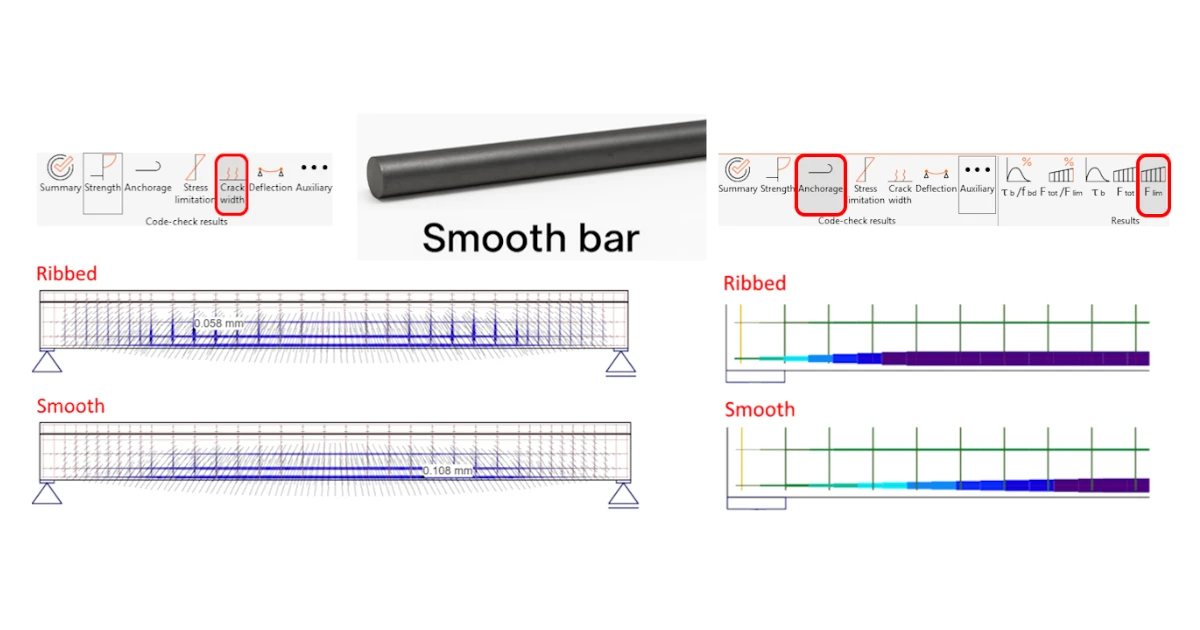
Many mid-20th-century designs used smooth rebars, whose bond behavior is significantly weaker than ribbed bars. Since design codes (EN, ACI, AS) are primarily based on ribbed reinforcement, this difference affects anchorage length, crack spacing, and stiffness modeling. With IDEA StatiCa Detail, it is possible accurately model and verify structures with smooth rebars, improving the reliability of crack width calculations and anchorage checks. This makes Detail a reliable tool for retrofitting and assessing older buildings, bridges, and precast elements.

The option is available for all implemented codes.

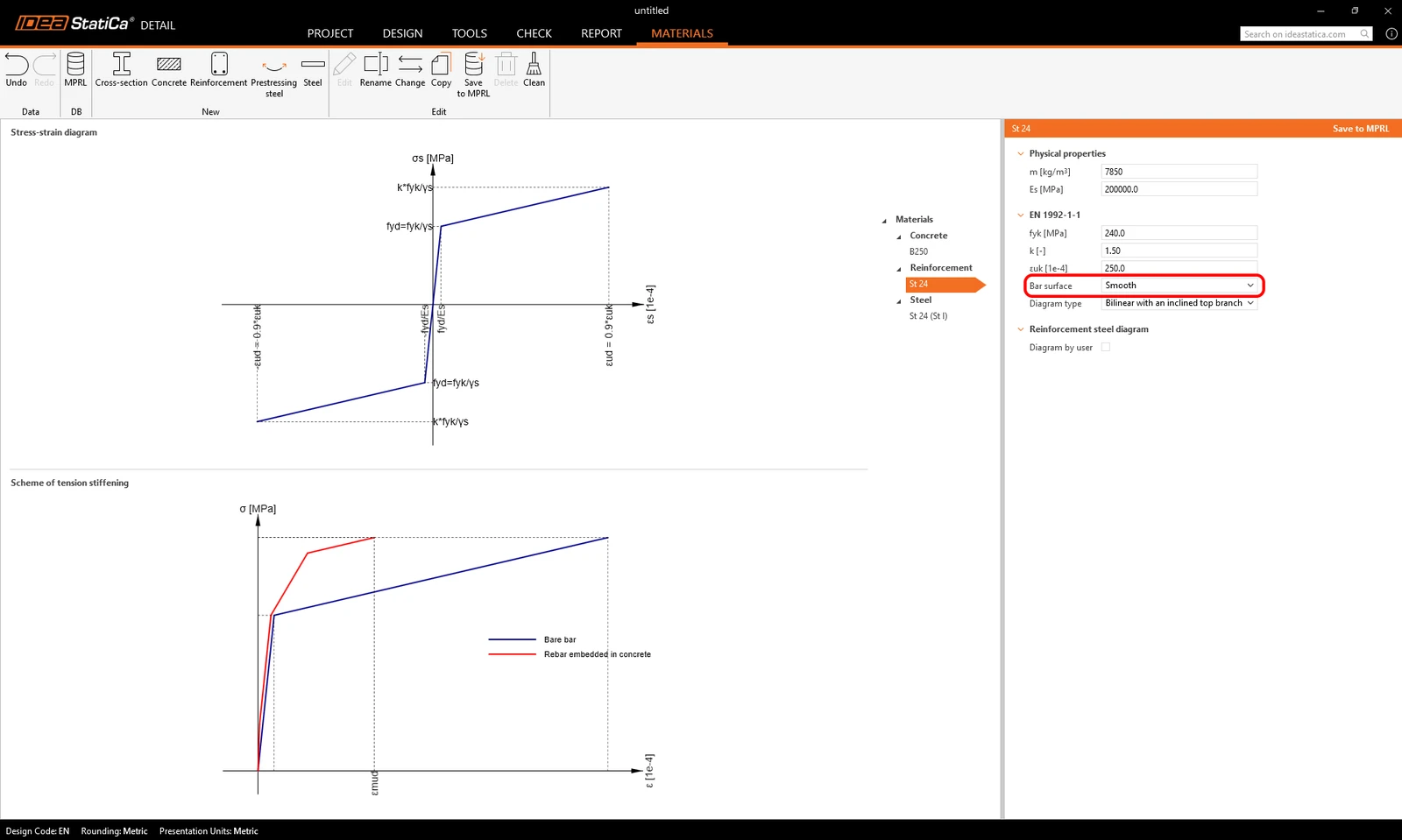
Switching the reinforcement type is possible in the Material Tab, where you can choose between two options: Ribbed to Smooth.
Reduction factors

For ACI and AUS, the reduction factors for bond and anchorage length follow code definitions; for EN, values are inspired by fib Model Code 2010 but can be adjusted by the user.

For consistency, the same reduction applied to bond strength in each design code is also used to scale the anchorage coefficient ฮฒ in the CSFM (Compatible Stress Field Method) model. This ensures that the anchorage types, straight bar, hook, loop, etc., are correctly adjusted when smooth rebars are selected.
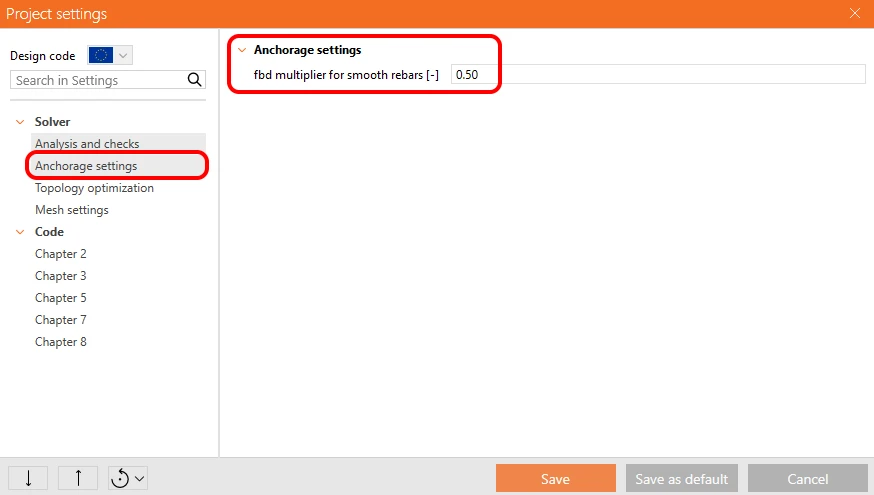
Code-specific adjustments for smooth rebars

  • EN 1992-1-1: Eurocode 2 does not explicitly cover smooth reinforcement in terms of bond strength (EN 1992-1-1:2004, CL. 8.4.2). For crack spacing calculation (CL. 7.3.4), the code implicitly assumes ribbed reinforcement. Based on research, other codes, and guidance from fib Model Code 2010 (CL. 6.1, Table 6.1-2), this is implemented as a user-defined multiplier โ€œfbd multiplier for smooth rebars,โ€ defaulting to 0.5.
  • ACI 318-19: Current ACI 318 (CL. 25.4.2.1) addresses development length only for deformed bars. Historical provisions in ACI 318-63 (ยง1402) specify that the required development length for plain (smooth) bars is twice that of deformed bars. Accordingly, Detail adopts a 0.5 bond reduction factor, consistent with this long-standing definition.
  • AS 3600:2018: Clause C13.1.3 explicitly defines the development length for plain (smooth) bars as 1.5 Lsy,t, compared to Lsy,t for deformed bars. This corresponds to a bond reduction factor of 0.67, which is directly applied in anchorage and crack spacing checks.

The Tension chord model and Pull-out model were updated to reflect the reduced bond and different crack development of smooth rebars. For more information on the models, see the Theoretical Background.
Try out the new features of IDEA StatiCa today

Download the latest version for free

Related articles

Release notes IDEA StatiCa 25.1
  • Steel
  • Concrete
  • v25.1
  • +3
  • Steel
  • Concrete
  • v25.1

Release notes

Release notes IDEA StatiCa 25.1

Read more
Prestressing in Detail โ€“ unbonded tendons
  • Concrete
  • v25.1
  • Prestressed members
  • +3
  • Concrete
  • v25.1
  • Prestressed members

Knowledge base

Prestressing in Detail โ€“ unbonded tendons

Read more
Advanced results presentation
  • Concrete
  • v25.1
  • +2
  • Concrete
  • v25.1

Knowledge base

Advanced results presentation

Read more
Australian code for Detail
  • Concrete
  • AS (Australia)
  • Detail 2D
  • v25.0
  • v25.1
  • Detail 3D
  • +6
  • Concrete
  • AS (Australia)
  • Detail 2D
  • v25.0
  • v25.1
  • Detail 3D

Knowledge base

Australian code for Detail

Read more