Idea Statica
  • Steel
  • Concrete
  • BIM & Workflows
  • Support & Learning
  • Pricing
  • Company
  • Steel overview
  • Connection design
  • Member design
  • Parametric design
  • Steel case studies
  • Concrete overview
  • Walls and D-regions
  • Anchoring design
  • Concrete case studies
  • BIM Overview
  • Supported integrations
  • Checkbot
  • Viewer
  • APIs
  • Support Center
  • E-learning & certification
  • Blog
  • Downloads & Licensing
  • Plans
  • Free community tool
  • Enterprise customers
  • Students & educators
  • How much will you save?
  • About us
  • Contact
  • Research & development
  • Authorized resellers
  • Meet our customers
  • Career
  • Steel
    Steel overviewConnection designMember designParametric designSteel case studies
  • Concrete
    Concrete overviewWalls and D-regionsAnchoring designConcrete case studies
  • BIM & Workflows
    BIM OverviewSupported integrationsCheckbotViewerAPIs
  • Support & Learning
    Support CenterE-learning & certificationBlogDownloads & Licensing
  • Pricing
    PlansFree community toolEnterprise customersStudents & educatorsHow much will you save?
  • Company
    About usContactResearch & developmentAuthorized resellersMeet our customersCareer
14-Day Trial
14-Day Trial
  • Steel
  • Concrete
  • BIM & Workflows
  • Support & Learning
  • Pricing
  • Company

Subscribe to our newsletter

Company

  • About us
  • Partners
  • Careers
  • Patent

Resources

  • Customer projects
  • Case studies
  • Connection Library
  • Verification books

Legal

  • EULA
  • Privacy policy
  • California Privacy
  • TOS Viewer
  • Licensing

Help

  • Contact
  • Quote request
  • Resellers
  • Downloads
FacebookInstagramLinkedInYouTube

© IDEA StatiCa 2009-2026

Trusted and used worldwide by engineers, fabricators & consultants.

Support CenterKnowledge Base ArticlesSingularities vs. stress concentration area
General description of Auxiliary results in Detail application
General description of SLS results in Detail application
General description of Summary results in Detail application
General description of ULS results in Detail application
Singularities vs. stress concentration area
Thorough CSFM results available
Crack width check improvements
Limited stress check feature in Detail
Presentation of relevant curve results in detailed graphs in IDEA StatiCa Detail
Anchorage check step by step
Singularities vs. stress concentration area
SteelConnection designMember designConcreteReinforced concrete

Singularities vs. stress concentration area

This article is also available in
ENCZDEESFRITPTNLHUROKRPLTHTRVIZH

In this article, learn about how singularities and stress concentration areas differ. Although similar in behavior, their differences are important to understand, especially when it comes to dealing with them effectively.

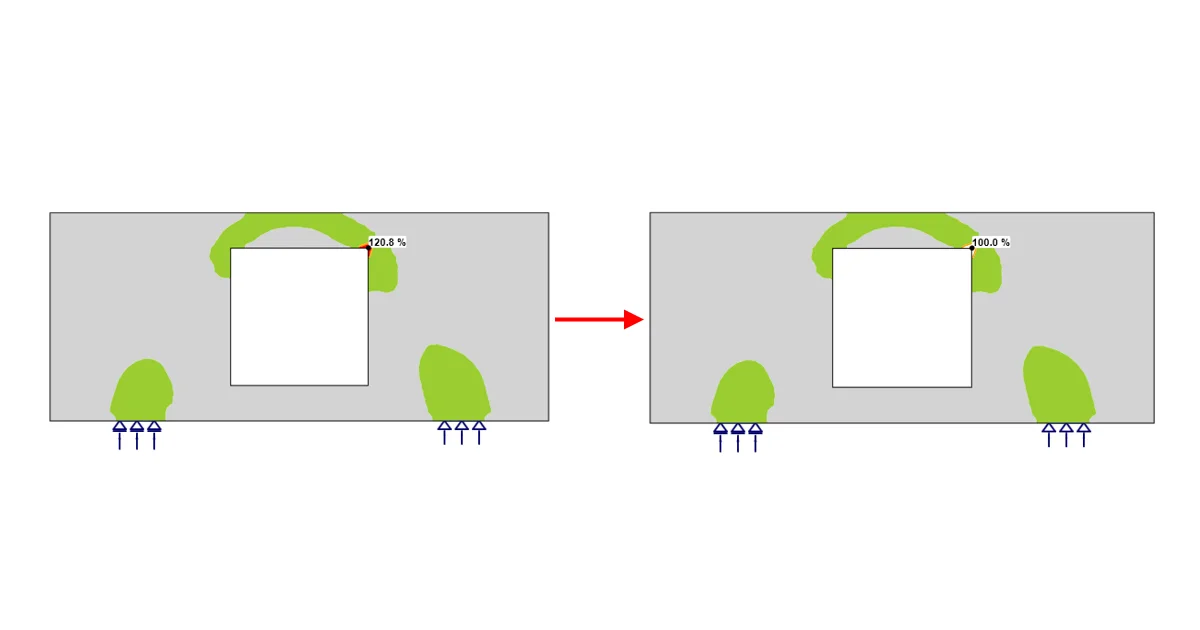
The sharp corner created at the junction of the coupling beam and shear wall creates a local stress peak that skews the model results. This peak is caused by the singularities at the point of the sharp re-entrant corner. The question is how to deal with these peaks in the models themselves.

Singularities

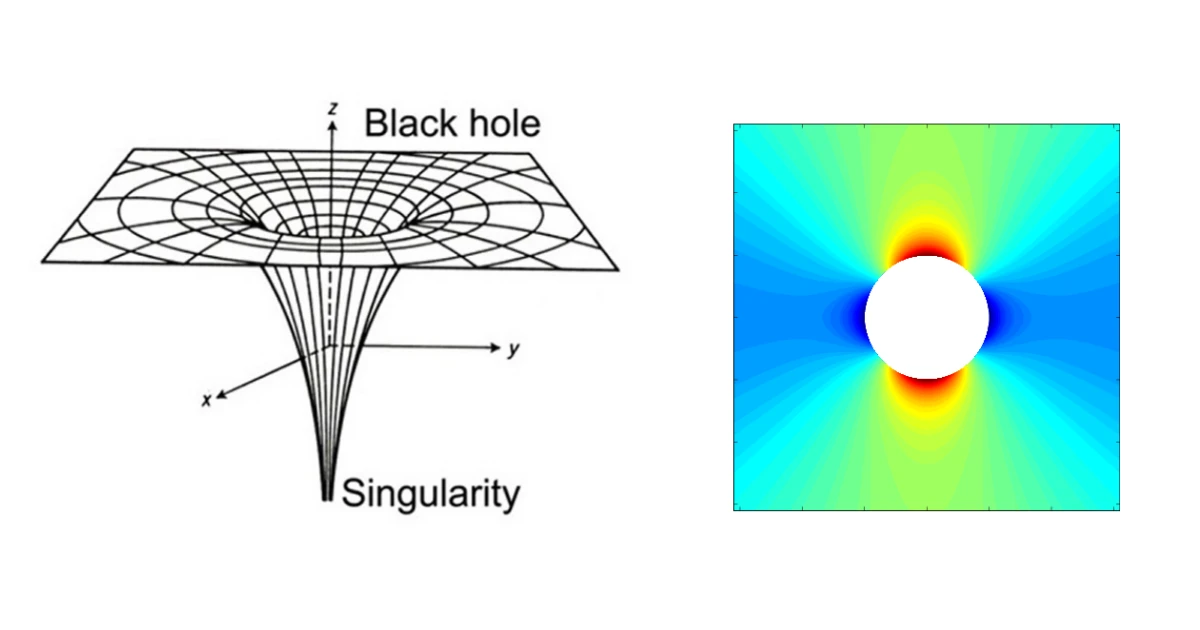
A stress singularity is a point of the mesh where the stress does not converge towards a specific value. As we keep refining the mesh, the stress at this point keeps increasing. Theoretically, the stress at the singularity is infinite. Typical situations where stress singularities occur are the appliance of a point load, sharp re-entrant corners, corners of bodies in contact, and point restraints.

In reality, no corner is perfectly sharp. Even if detailed this way, a manufactured sharp corner will always present a small fillet radius. This means that the stress will not be infinite anymore and the corner singularity will disappear. Instead, stress concentration takes over.
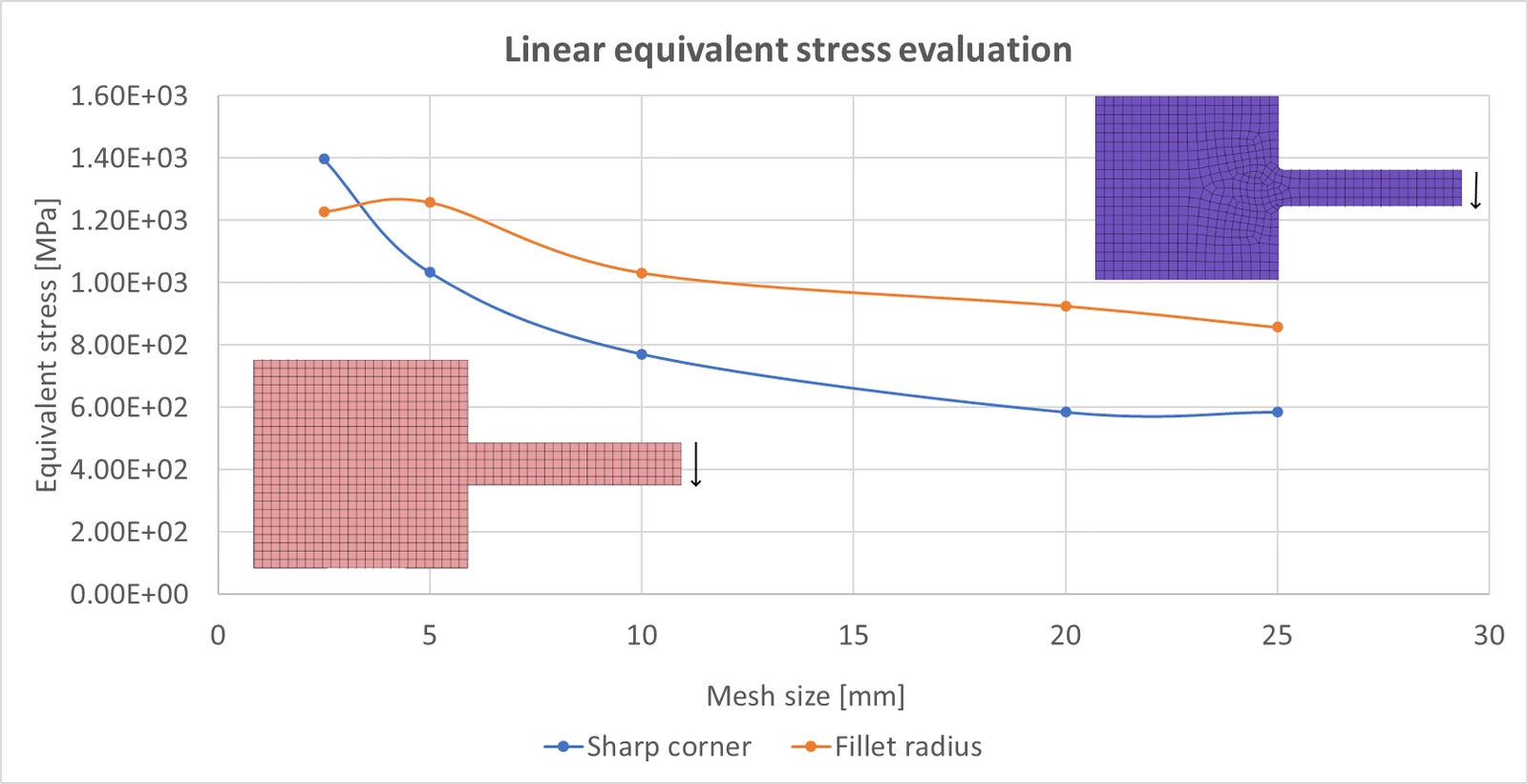
The relationship between mesh stress concentration behavior

Figure 6. A sensitivity study was performed on the material linear model to find the relationship between mesh stress concentration behavior.  

Stress concentration

Stress concentration behaves similarly to stress singularities, but the stress will converge towards a finite value, not infinite, given that the mesh is sufficiently refined. Features such as holes, filleted corners, changes of cross-section, etc., will lead to stress concentrations.

  • A coarse mesh will not capture local effects such as stress concentrations.
  • The more we refine the mesh, the more accurate the results are. However, the model is not computationally efficient. The Saint Venant's principle says that the effect should be local. Therefore, the mesh could be refined locally rather than globally, subdividing all the elements in the mesh.
  • Plasticity helps to ensure correct behavior and suppress the singularity effect.
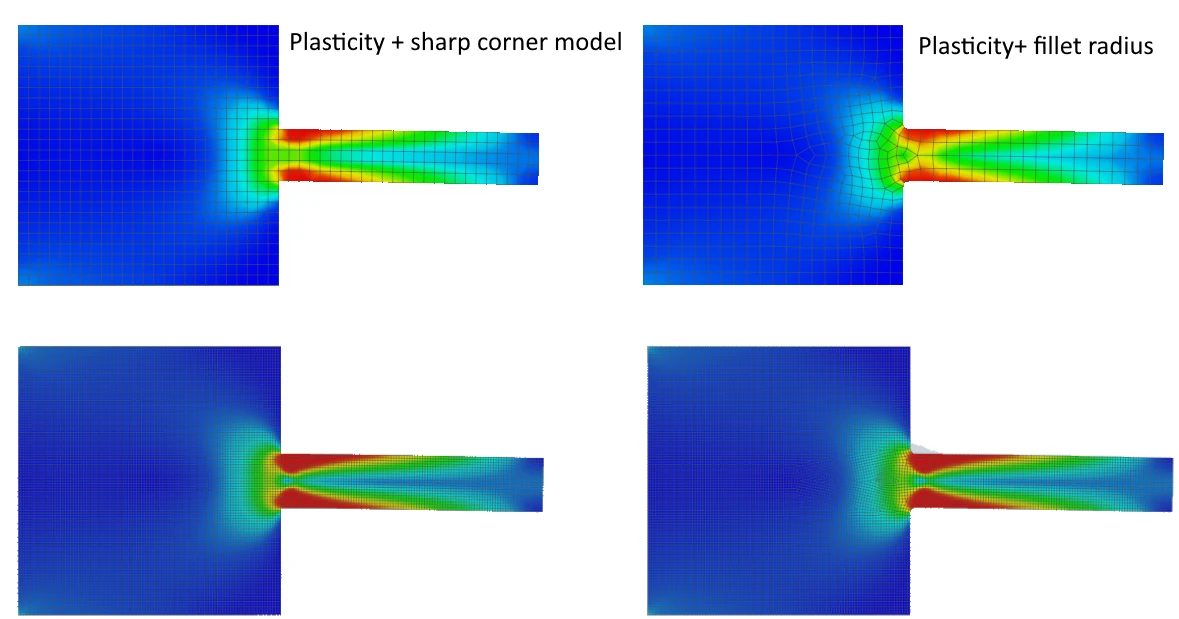
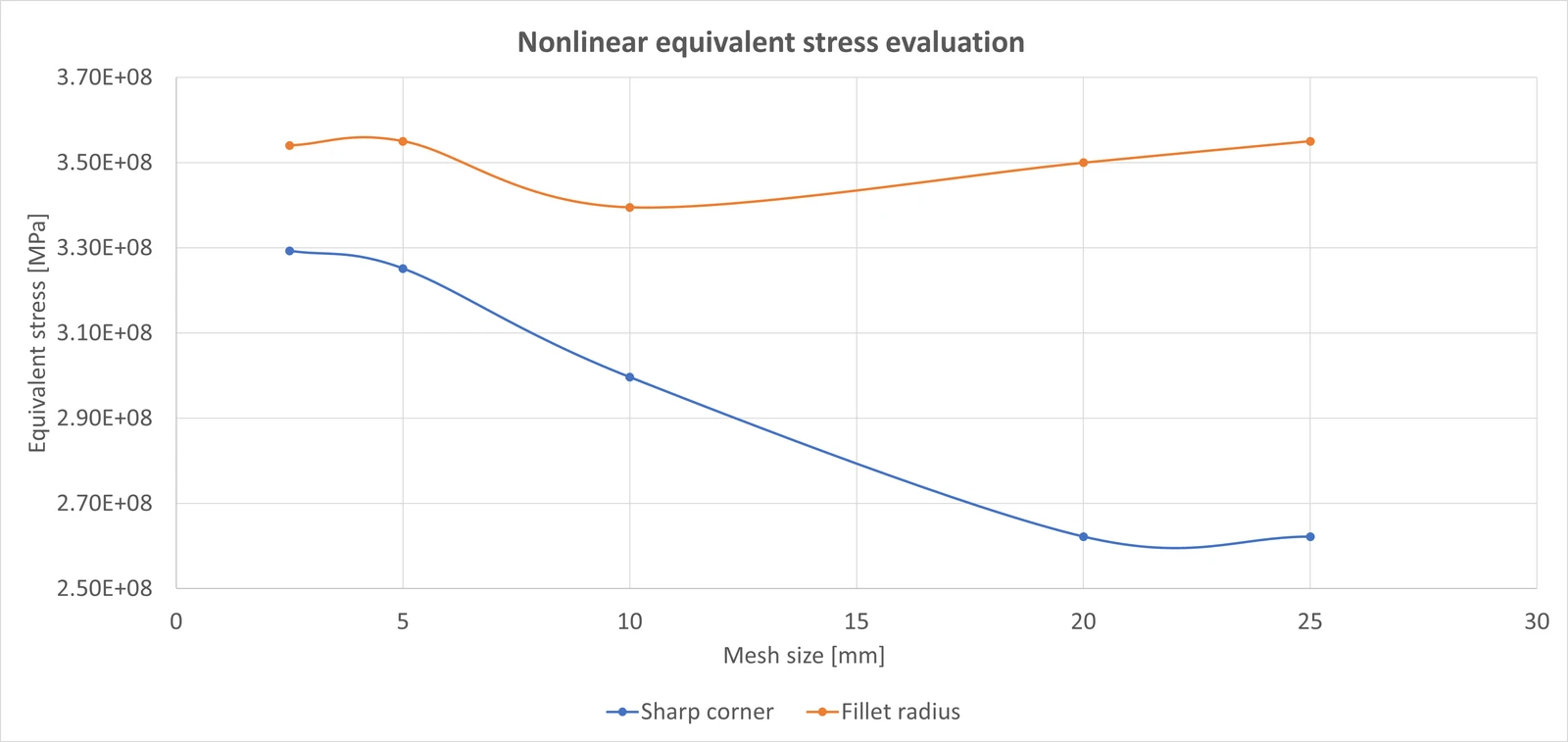
Relationship between mesh size and sharp and fillet corner equivalent stress

Figure 7. A sensitivity study was performed on the material nonlinear model to find the relationship between mesh size and sharp and fillet corner equivalent stress.  

How to deal with singularities and stress concentrations

  • Ignore the singularities. If we are interested in the stresses far away from any singularities, the Saint Venant's principle applies – the stresses will be correct.
  • The mesh must be locally refined to capture the stress concentration effect.
  • Typical geometric-induced singularities, such as sharp re-entrant corners, can be avoided by modeling fillets instead. Effectively, the stress singularity becomes a stress concentration.
  • Plasticity allows the model to behave according to reality, and the singularity effect vanishes.
  • The mesh should be refined to verify that stresses do converge. This requires a mesh sensitivity study.
Don't waste time with SLS checks
  • Concrete
  • Detail 2D
  • EN (Eurocode)
  • ACI (USA)
  • CSFM
  • Prestressing losses
  • SLS
  • +7
  • Concrete
  • Detail 2D
  • EN (Eurocode)
  • ACI (USA)
  • CSFM
  • Prestressing losses
  • SLS

Blog post

Don't waste time with SLS checks

Read more
Code and calculation settings in Detail application
  • Concrete
  • Detail 2D
  • EN (Eurocode)
  • +3
  • Concrete
  • Detail 2D
  • EN (Eurocode)

Knowledge base

Code and calculation settings in Detail application

Read more
General description of SLS results in Detail application
  • Concrete
  • Detail 2D
  • EN (Eurocode)
  • Overall check
  • +4
  • Concrete
  • Detail 2D
  • EN (Eurocode)
  • Overall check

Knowledge base

General description of SLS results in Detail application

Read more
Limited stress check feature in Detail
  • Concrete
  • Detail 2D
  • SLS
  • v23.0
  • +4
  • Concrete
  • Detail 2D
  • SLS
  • v23.0

Knowledge base

Limited stress check feature in Detail

Read more