Idea Statica
  • Steel
  • Concrete
  • BIM & Workflows
  • Support & Learning
  • Pricing
  • Company
  • Steel overview
  • Connection design
  • Member design
  • Parametric design
  • Steel case studies
  • Concrete overview
  • Walls and D-regions
  • Anchoring design
  • Concrete case studies
  • BIM Overview
  • Supported integrations
  • Checkbot
  • Viewer
  • APIs
  • Support Center
  • E-learning & certification
  • Blog
  • Downloads & Licensing
  • Plans
  • Free community tool
  • Enterprise customers
  • Students & educators
  • How much will you save?
  • About us
  • Contact
  • Research & development
  • Authorized resellers
  • Meet our customers
  • Career
  • Steel
    Steel overviewConnection designMember designParametric designSteel case studies
  • Concrete
    Concrete overviewWalls and D-regionsAnchoring designConcrete case studies
  • BIM & Workflows
    BIM OverviewSupported integrationsCheckbotViewerAPIs
  • Support & Learning
    Support CenterE-learning & certificationBlogDownloads & Licensing
  • Pricing
    PlansFree community toolEnterprise customersStudents & educatorsHow much will you save?
  • Company
    About usContactResearch & developmentAuthorized resellersMeet our customersCareer
14-Day Trial
14-Day Trial
  • Steel
  • Concrete
  • BIM & Workflows
  • Support & Learning
  • Pricing
  • Company

Subscribe to our newsletter

Company

  • About us
  • Partners
  • Careers
  • Patent

Resources

  • Customer projects
  • Case studies
  • Connection Library
  • Verification books

Legal

  • EULA
  • Privacy policy
  • California Privacy
  • TOS Viewer
  • Licensing

Help

  • Contact
  • Quote request
  • Resellers
  • Downloads
FacebookInstagramLinkedInYouTube

© IDEA StatiCa 2009-2026

Trusted and used worldwide by engineers, fabricators & consultants.

Support CenterKnowledge Base ArticlesCode-check of steel plates (AISC)
Advanced analysis types for your steel structures
Why is 5% plastic strain limit used in material diagram for EN?
Why is 5% plastic strain limit used in material diagram for AISC?
Stress in plates higher than the yield strength
Contact stress between two plates
An improved model of contacts
Smooth results with precise meshing
Plate model and mesh convergence
Code-check of steel plates (EN)
Code-check of steel plates (AISC)
Code-check of steel plates according to Canadian standards
Code-check of steel plates according to Australian standards
Code-check of steel plates according to Chinese Standard
Code-check of plates according to Hong Kong Code
Design check of plates according to Indian standard
Code-check of steel plates according to Russian standards
Structural strain check is performed at shell finite elements simulating plates. The yield strength is decreased by resistance or safety factor. IDEA StatiCa - structural analysis software for steel member design.
Connection designSteelKnowledge baseConnectionCBFEM

Code-check of steel plates (AISC)

This article is also available in
ENCZDEESFRITPTNLHUROKRPLTHTRVIZH

The resulting equivalent stress (HMH, von Mises) and plastic strain are calculated on plates. When the yield strength (in LRFD multiplied by material resistance factor ϕ = 0.9, in ASD divided by material safety factor Ω = 1.67, which are editable in Code setup) on the bilinear material diagram is reached, the check of the equivalent plastic strain is performed. The limit value of 5 % is suggested in Eurocode (EN1993-1-5 App. C, Par. C8, Note 1). This value can be modified in the Code setup, but verification studies were made for this recommended value.

The plate element is divided into five layers, and elastic/plastic behavior is investigated in each of them. The program shows the worst result of all of them.
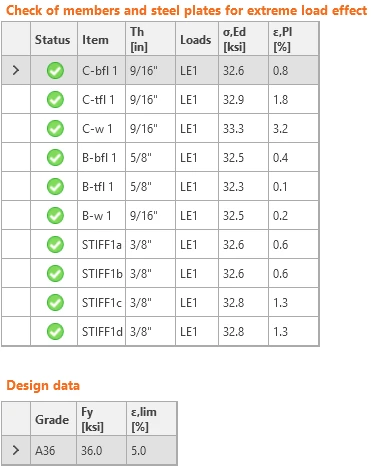
The CBFEM method can provide stress a little bit higher than yield strength. The reason is the slight inclination of the plastic branch of the stress-strain diagram, which is used in the analysis to improve the stability of the interaction calculation. This is not a problem for practical design. The equivalent plastic strain is exceeded at higher stress, and the joint does not satisfy anyway.
Related articles

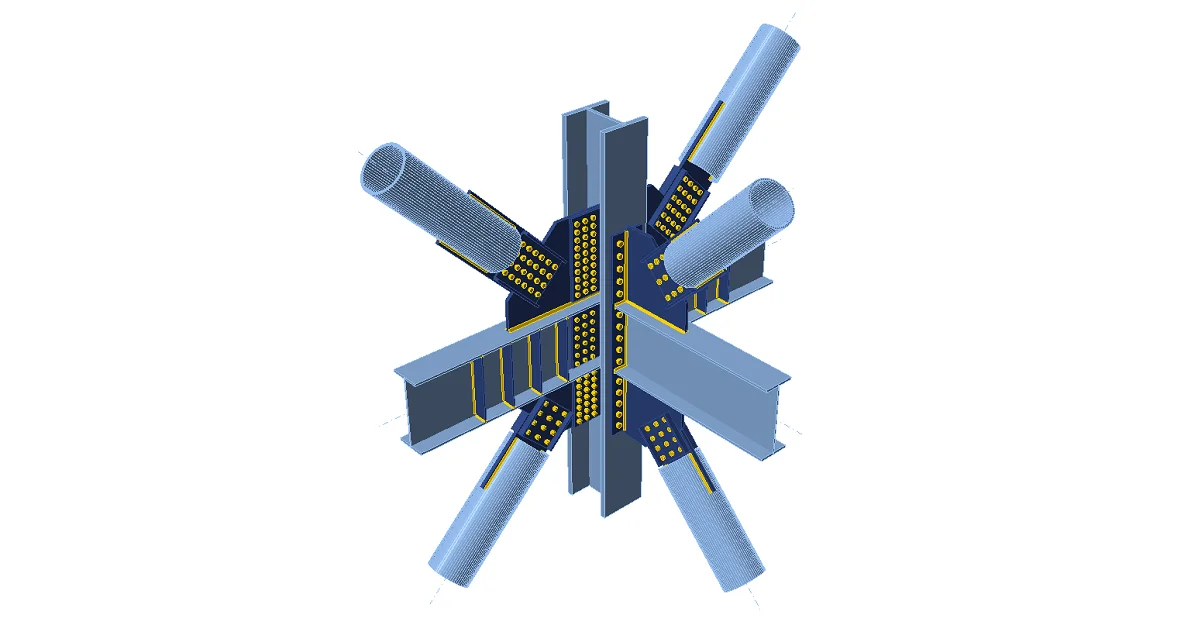
IDEA StatiCa Connection – Structural design of steel connections
  • Steel
  • Connection
  • EN (Eurocode)
  • AISC (USA)
  • AS (Australia)
  • CSA (Canada)
  • IS (India)
  • GB (China)
  • HKG (Hong Kong)
  • SP 16 (Russia)
  • CBFEM
  • +11
  • Steel
  • Connection
  • EN (Eurocode)
  • AISC (USA)
  • AS (Australia)
  • CSA (Canada)
  • IS (India)
  • GB (China)
  • HKG (Hong Kong)
  • SP 16 (Russia)
  • CBFEM

Theoretical background

IDEA StatiCa Connection – Structural design of steel connections

Read more
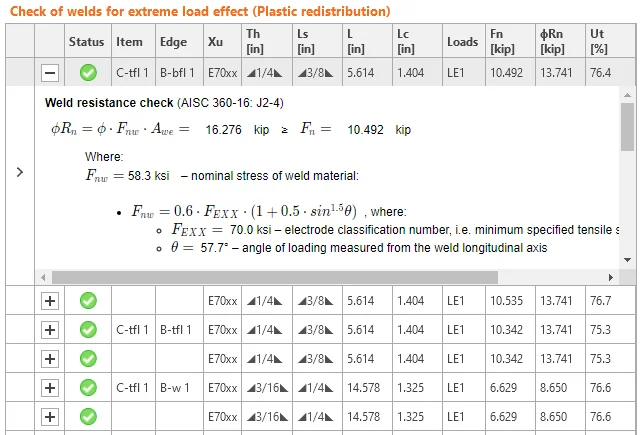
Fillet welds are checked according to AISC 360 - Chapter J2. The strength of CJP groove welds is assumed the same as the base metal and is not checked. IDEA StatiCa - structural engineering design software for modeling welded connections.
  • Steel
  • Connection
  • CBFEM
  • Welds
  • AISC (USA)
  • +5
  • Steel
  • Connection
  • CBFEM
  • Welds
  • AISC (USA)

Knowledge base

Code-check of welds (AISC)

Read more
Distance between plates connected by a contact
  • Steel
  • Connection
  • Contacts
  • Bolts
  • Plates
  • +5
  • Steel
  • Connection
  • Contacts
  • Bolts
  • Plates

Knowledge base

Distance between plates connected by a contact

Read more
Single Plate Shear Connections (AISC)
  • Steel
  • Connection
  • Bolts
  • AISC (USA)
  • +4
  • Steel
  • Connection
  • Bolts
  • AISC (USA)

Verifications

Single Plate Shear Connections (AISC)

Read more