Idea Statica
  • Steel
  • Concrete
  • BIM & Workflows
  • Support & Learning
  • Pricing
  • Company
  • Steel overview
  • Connection design
  • Member design
  • Parametric design
  • Steel case studies
  • Concrete overview
  • Walls and D-regions
  • Anchoring design
  • Concrete case studies
  • BIM Overview
  • Supported integrations
  • Checkbot
  • Viewer
  • APIs
  • Support Center
  • E-learning & certification
  • Blog
  • Downloads & Licensing
  • Plans
  • Free community tool
  • Enterprise customers
  • Students & educators
  • How much will you save?
  • About us
  • Contact
  • Research & development
  • Authorized resellers
  • Meet our customers
  • Career
  • Steel
    Steel overviewConnection designMember designParametric designSteel case studies
  • Concrete
    Concrete overviewWalls and D-regionsAnchoring designConcrete case studies
  • BIM & Workflows
    BIM OverviewSupported integrationsCheckbotViewerAPIs
  • Support & Learning
    Support CenterE-learning & certificationBlogDownloads & Licensing
  • Pricing
    PlansFree community toolEnterprise customersStudents & educatorsHow much will you save?
  • Company
    About usContactResearch & developmentAuthorized resellersMeet our customersCareer
14-Day Trial
14-Day Trial
  • Steel
  • Concrete
  • BIM & Workflows
  • Support & Learning
  • Pricing
  • Company

Subscribe to our newsletter

Company

  • About us
  • Partners
  • Careers
  • Patent

Resources

  • Customer projects
  • Case studies
  • Connection Library
  • Verification books

Legal

  • EULA
  • Privacy policy
  • California Privacy
  • TOS Viewer
  • Licensing

Help

  • Contact
  • Quote request
  • Resellers
  • Downloads
FacebookInstagramLinkedInYouTube

ยฉ IDEA StatiCa 2009-2026

Trusted and used worldwide by engineers, fabricators & consultants.

Support CenterKnowledge Base ArticlesStress in plates higher than the yield strength
Advanced analysis types for your steel structures
Why is 5% plastic strain limit used in material diagram for EN?
Why is 5% plastic strain limit used in material diagram for AISC?
Stress in plates higher than the yield strength
Contact stress between two plates
An improved model of contacts
Smooth results with precise meshing
Plate model and mesh convergence
Code-check of steel plates (EN)
Code-check of steel plates (AISC)
Code-check of steel plates according to Canadian standards
Code-check of steel plates according to Australian standards
Code-check of steel plates according to Chinese Standard
Code-check of plates according to Hong Kong Code
Design check of plates according to Indian standard
Code-check of steel plates according to Russian standards
Stress in plates higher than the yield strength
Connection designSteelMember designKnowledge baseConnection

Stress in plates higher than the yield strength

This article is also available in
ENCZDEESFRITPTNLHUROKRPLTHTRVIZH

The code-check of a steel plate in applications Connection and Member follow the Eurocode EN 1993-1-5 App. C, Par. C8, Note 1. This is very well applicable and verified for other codes and standards as well (such as AISC 360, etc.). Read the documents about the code-checks of components per national standards.ย 

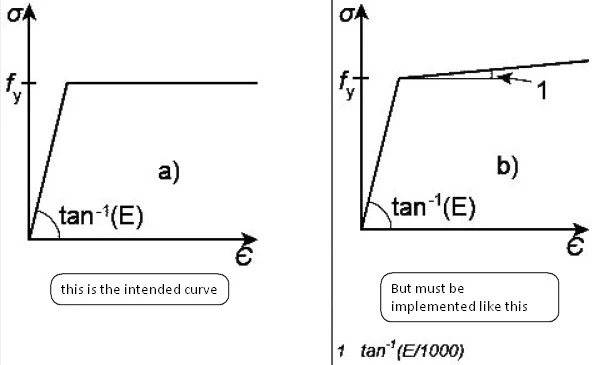
The main point is that the limit of the steel plate capacity is not the yield stress (e.g., 355 MPa for steel material S355) but the 5% plastic strain. This is summarized in the following picture taken from Figure C.2 ofย EN 1993-1-5 App. C, which shows the inclined top branch of the construction steel material working diagram (inclination tan-1 E/1000).
Stress in plates higher than the yield strength

This may lead to stress in plates exceeding the yield stress while still passing the code-check. As an outcome, this gives an extra capacity for the analysis models and thus material savings.

If you need to lower the plastic limit strain of a steel material or restrict your model to elastic behavior only, you can modify this in the Code setup by changing the Limit plastic strain and Warning plastic strain to 0 value.
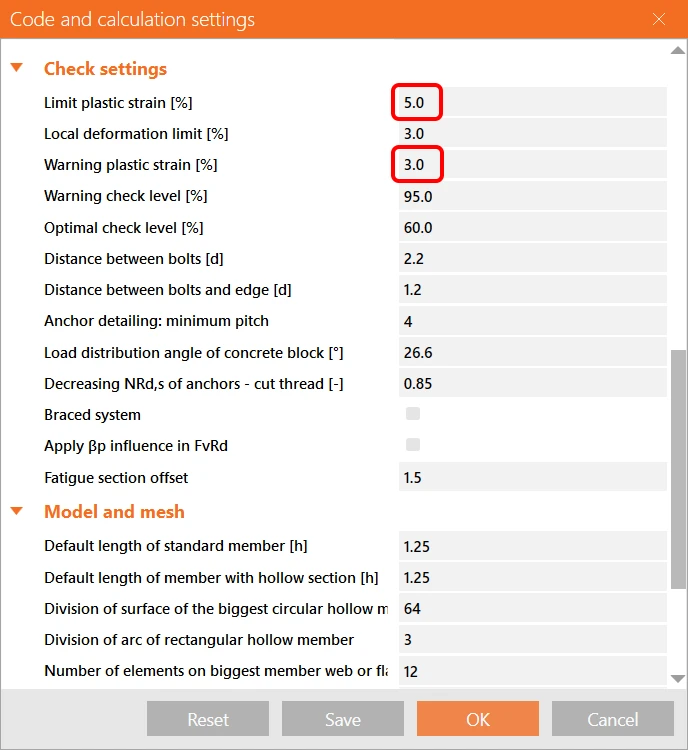
Note: By default, the ultimate criterion of the check is the strain limit of 5%. If your model satisfies this requirement, you donโ€™t need to check the stresses, but they are presented in the results overview for the sake of completeness.

Related articles

When a shear connection transmits a bending moment
  • Steel
  • Connection
  • Shear connection
  • Bolts
  • +4
  • Steel
  • Connection
  • Shear connection
  • Bolts

Blog post

When a shear connection transmits a bending moment

Read more
Rocky Mountain Metropolitan Airport drive-through canopy
  • Steel
  • Connection
  • AISC (USA)
  • Geometry
  • Load effects
  • Report
  • Overall check
  • CBFEM
  • Modeling
  • Stress/strain
  • Drawing
  • +11
  • Steel
  • Connection
  • AISC (USA)
  • Geometry
  • Load effects
  • Report
  • Overall check
  • CBFEM
  • Modeling
  • Stress/strain
  • Drawing

Case study

Rocky Mountain Metropolitan Airport drive-through canopy

Read more
Release notes IDEA StatiCa 26.0
  • Steel
  • Concrete
  • v26.0
  • +3
  • Steel
  • Concrete
  • v26.0

Release notes

Release notes IDEA StatiCa 26.0

Read more