Idea Statica
  • Steel
  • Concrete
  • Support & Learning
  • Pricing
  • Company
  • Steel overview
  • Connection design
  • Member design
  • Parametric design
  • Steel case studies
  • Concrete overview
  • Walls and D-regions
  • Anchoring design
  • Concrete case studies
  • BIM Overview
  • Supported integrations
  • Checkbot
  • Viewer
  • APIs
  • Support Center
  • E-learning & certification
  • Blog
  • Downloads & Licensing
  • Plans
  • Free community tool
  • Enterprise customers
  • Students & educators
  • How much will you save?
  • About us
  • Contact
  • Research & development
  • Authorized resellers
  • Meet our customers
  • Career
  • Steel
    Steel overviewConnection designMember designParametric designSteel case studies
  • Concrete
    Concrete overviewWalls and D-regionsAnchoring designConcrete case studies
  • BIM OverviewSupported integrationsCheckbotViewerAPIs
  • Support & Learning
    Support CenterE-learning & certificationBlogDownloads & Licensing
  • Pricing
    PlansFree community toolEnterprise customersStudents & educatorsHow much will you save?
  • Company
    About usContactResearch & developmentAuthorized resellersMeet our customersCareer
14-Day Trial
14-Day Trial

Subscribe to our newsletter

Company

  • About us
  • Partners
  • Careers
  • Patent

Resources

  • Customer projects
  • Case studies
  • Connection Library
  • Verification books

Legal

  • EULA
  • Privacy policy
  • California Privacy
  • TOS Viewer
  • Licensing

Help

  • Contact
  • Quote request
  • Resellers
  • Downloads
FacebookInstagramLinkedInYouTube

ยฉ IDEA StatiCa 2009-2026

Trusted and used worldwide by engineers, fabricators & consultants.

Support CenterKnowledge Base ArticlesCalculation of anchors with stand-off
Advanced analysis types for your steel structures
Concrete cone area of single anchor and group of anchors
Effective area in check of contact stress in concrete
EN anchoring code-check improvement
Limitations to checks of anchors
Anchorageย formulas, tooltips
Calculation of anchors with stand-off
Hooked anchors/L-bolts in AISC
Import of anchoring from Connection to Detail
Automatic anchoring code-selection with hooked anchors
Anchor bolts
Structural model of a concrete block
Code-check of anchors (EN)
Code-check of concrete blocks (EN)
Code-check of anchors (AISC)
Code-check of concrete blocks (AISC)
Code-check of anchors according to Canadian standards
Code-check of concrete block according to Canadian standards
Code-check of anchors according to Australian standards
Check of anchor tension as a bolt tension option (AS)
Code-check of concrete block according to Australian standards
Russian Standard (SP) anchorage
Code-check of anchors according to Chinese standard
Code-check of concrete block according to Chinese standard
Code-check of concrete block according to Hong Kong Code
Code-check of concrete block according to Indian standards
Check of anchors according to STO
Code-check of concrete block according to Russian standards
Check of concrete block according to SP - new
Calculation of anchors with stand-off
SteelConnection designKnowledge baseConnectionAnchoring

Calculation of anchors with stand-off

This article is also available in
ENCZDEESFRITPTNLHUROKRPLTHTRVIZH

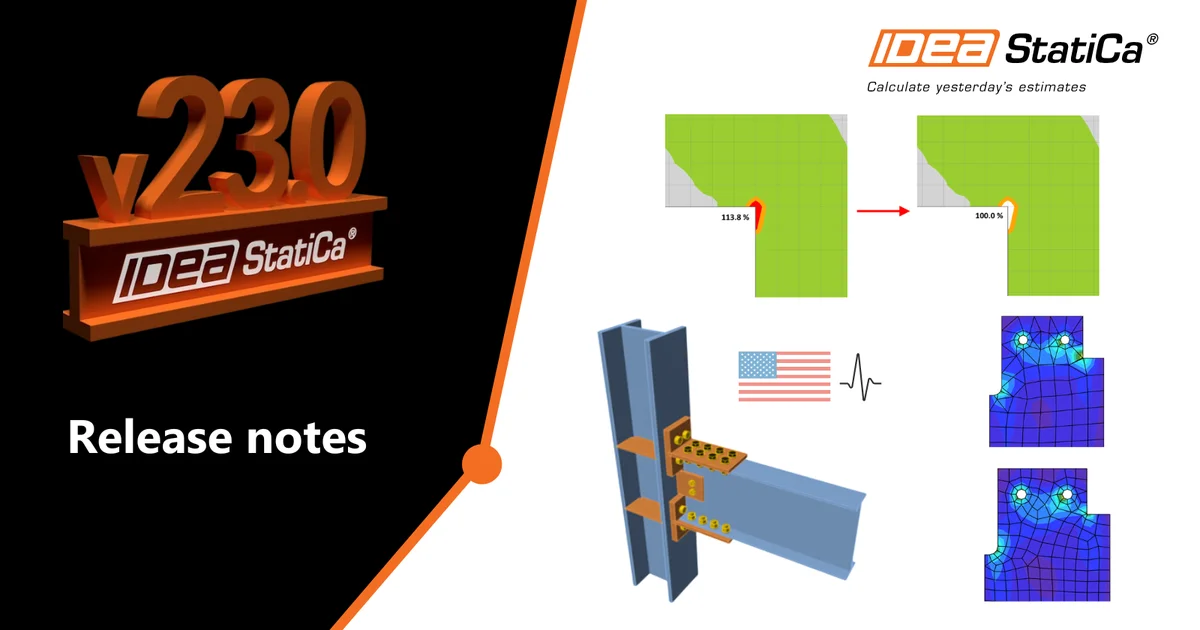
In version 23.0, IDEA StatiCa provides a new feature regarding RN 23.0: Anchors with stand-off.

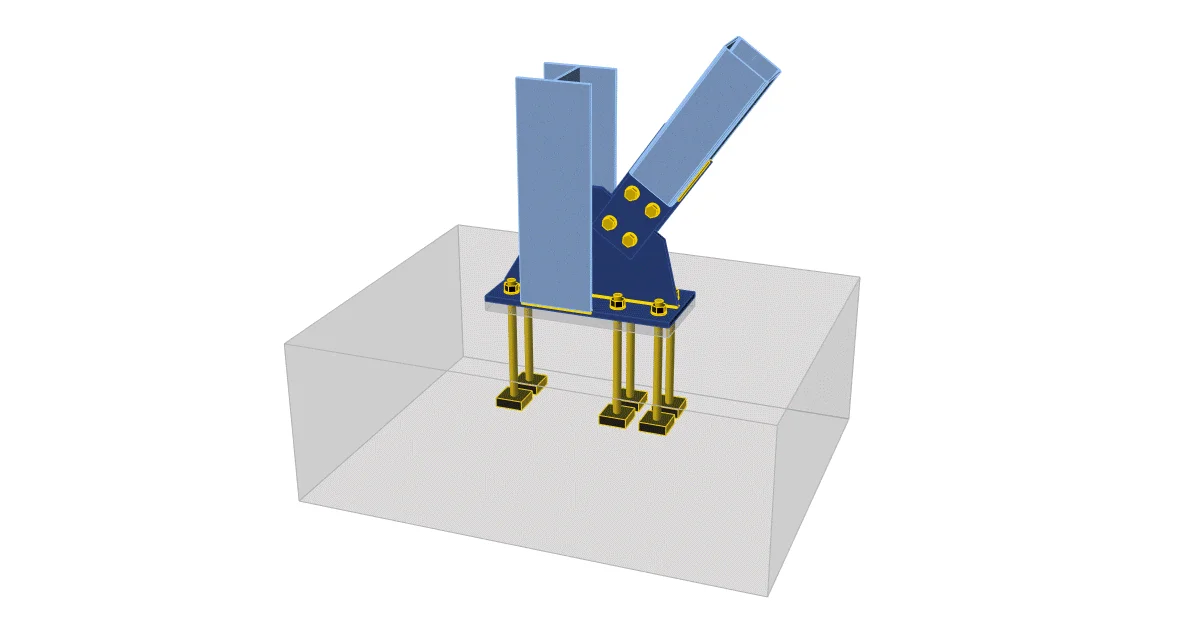
An anchor with stand-off is designed as a bar element loaded by compressive or tensile force, shear force, and bending moment. The calculation of the bending moment has been improved to respect better the real behavior of stand-off anchors.

The value of the bending moment depends on the ratio between base plate stiffness and anchor stiffness. For a very weak plate and stiff anchors, the bending moment in the anchor will be as follows:

Calculation of anchors with stand-off

For stiff plate and weak anchors, the bending moment will look like this:

Calculation of anchors with stand-off

In previous versions, the bending moment in stand-off anchoring was always calculated as in the first case, assuming a weak plate and stiff anchors. The lever arm for moment calculation was the distance between the mid-plane of the plate and the concrete plus one-half of the anchor diameter. This was quite an over-conservative approach.

Since release 22.1.5, the calculation of the bending moment has been updated. The value is determined directly by the finite element model. The anchor is modelled as a beam element and moments in it respect the actual stiffness of the system. The anchor is fixed on both sides, one side is 0.5ร—dย below the concrete level, and the other side is in the mid-plane of the plate. The extreme of the calculated moment is taken into account in the code check then.

More information regarding the code checking of anchors can be found in the theoretical background. Individual codes can be found here: EC, AISC, AS, STO.

Available in both Expert andย Enhancedย editions ofย IDEA StatiCa Steel.

Download the new version of IDEA StatiCa and try all the features

Download new version

Related articles

Release notes IDEA StatiCa 23.0
  • Concrete
  • Steel
  • Connection
  • Detail 2D
  • Member
  • Checkbot
  • Viewer
  • RCS
  • IDEA Open Model (API)
  • ACI (USA)
  • AISC (USA)
  • BIM link
  • EN (Eurocode)
  • v23.0
  • +14
  • Concrete
  • Steel
  • Connection
  • Detail 2D
  • Member
  • Checkbot
  • Viewer
  • RCS
  • IDEA Open Model (API)
  • ACI (USA)
  • AISC (USA)
  • BIM link
  • EN (Eurocode)
  • v23.0

Release notes

Release notes IDEA StatiCa 23.0

Read more
Safe and accurate anchoring design
  • Steel
  • Anchoring
  • CBFEM
  • Connection
  • Steel-to-concrete
  • +5
  • Steel
  • Anchoring
  • CBFEM
  • Connection
  • Steel-to-concrete

Blog post

Safe and accurate anchoring design

Read more
General anchoring shapes and options
  • Steel
  • Connection
  • Geometry
  • Anchoring
  • Concrete block
  • Plates
  • Steel-to-concrete
  • Hilti
  • +8
  • Steel
  • Connection
  • Geometry
  • Anchoring
  • Concrete block
  • Plates
  • Steel-to-concrete
  • Hilti

Knowledge base

General anchoring shapes and options

Read more
Structural design and code-check of anchors according to Eurocode. The forces in anchors, including prying forces, are determined by finite element analysis, but the resistances are checked using code provisions of EN 1992-4.
  • Steel
  • Connection
  • Anchoring
  • CBFEM
  • Steel-to-concrete
  • EN (Eurocode)
  • +6
  • Steel
  • Connection
  • Anchoring
  • CBFEM
  • Steel-to-concrete
  • EN (Eurocode)

Knowledge base

Code-check of anchors (EN)

Read more