Idea Statica
  • Steel
  • Concrete
  • BIM & Workflows
  • Support & Learning
  • Pricing
  • Company
  • Steel overview
  • Connection design
  • Member design
  • Parametric design
  • Steel case studies
  • Concrete overview
  • Walls and D-regions
  • Anchoring design
  • Concrete case studies
  • BIM Overview
  • Supported integrations
  • Checkbot
  • Viewer
  • APIs
  • Support Center
  • E-learning & certification
  • Blog
  • Downloads & Licensing
  • Plans
  • Free community tool
  • Enterprise customers
  • Students & educators
  • How much will you save?
  • About us
  • Contact
  • Research & development
  • Authorized resellers
  • Meet our customers
  • Career
  • Steel
    Steel overviewConnection designMember designParametric designSteel case studies
  • Concrete
    Concrete overviewWalls and D-regionsAnchoring designConcrete case studies
  • BIM & Workflows
    BIM OverviewSupported integrationsCheckbotViewerAPIs
  • Support & Learning
    Support CenterE-learning & certificationBlogDownloads & Licensing
  • Pricing
    PlansFree community toolEnterprise customersStudents & educatorsHow much will you save?
  • Company
    About usContactResearch & developmentAuthorized resellersMeet our customersCareer
14-Day Trial
14-Day Trial
  • Steel
  • Concrete
  • BIM & Workflows
  • Support & Learning
  • Pricing
  • Company

Subscribe to our newsletter

Company

  • About us
  • Partners
  • Careers
  • Patent

Resources

  • Customer projects
  • Case studies
  • Connection Library
  • Verification books

Legal

  • EULA
  • Privacy policy
  • California Privacy
  • TOS Viewer
  • Licensing

Help

  • Contact
  • Quote request
  • Resellers
  • Downloads
FacebookInstagramLinkedInYouTube

ยฉ IDEA StatiCa 2009-2026

Trusted and used worldwide by engineers, fabricators & consultants.

Support CenterKnowledge Base ArticlesNode equilibrium in the 3D FEM model
Different ways to define load effects
Equilibrium and supporting member
Principles of Loading in a Connection: Equilibrium, bearing member etc.
Key insights into constraints, member length and GMNA vs MNA analysis
Calculate load extremes
Shear force position input and visualization
When a shear connection transmits a bending moment
Loads in equilibrium by default
How to import load effects from Excel sheet
Percentage loading
Node equilibrium in the 3D FEM model
Internal forces in the steel connections
The right LCS (local coordinate system) orientation
Structural design of welded and bolted connections. The loads in any node in the structural model need to be in equilibrium. Any unbalanced forces are taken by supports. IDEA StatiCa - structural analysis software.
SteelConnection designKnowledge baseConnectionAISC (USA)

Node equilibrium in the 3D FEM model

This article is also available in
ENCZDEESFRITPTNLHUROKRPLTHTRVIZH

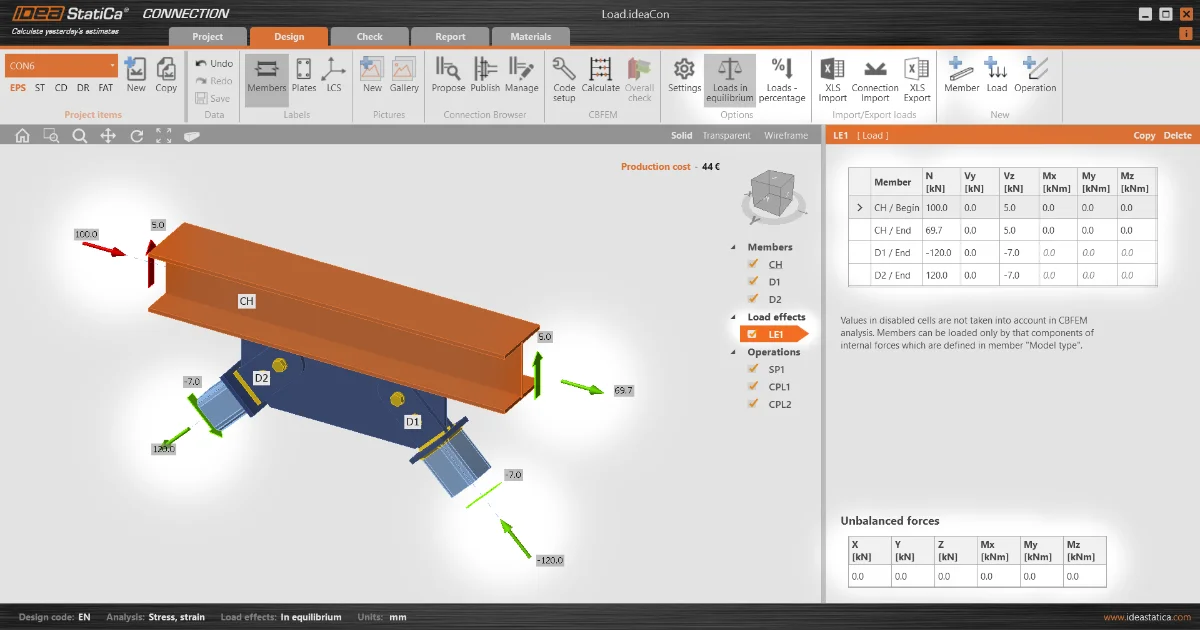
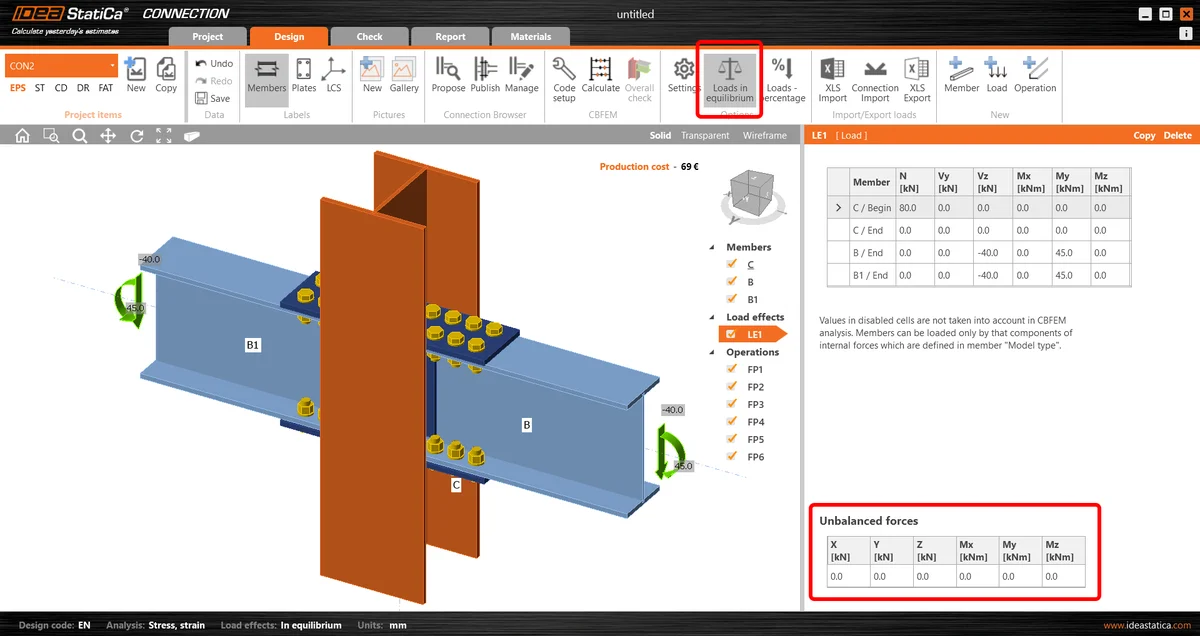
The loads in any node in the structural model need to be in equilibrium. Any unbalanced forces are taken by supports. It is recommended to use a load combination instead of an internal forces envelope.

Each node of the 3D FEM model must be in equilibrium. The equilibrium requirement is correct, nevertheless, it is not necessary for the design of simple joints. One member of the joint is always โ€žbearing, โ€œ and the others are connected. If only the connection of connected members is checked, it is not necessary to keep the equilibrium. Thus, there are two modes of load input available:

  • Simplified โ€“ for this mode, the bearing member is supported (continuous member on both sides), and the load is not defined on the member
  • Advanced (exact with equilibrium check) โ€“ the bearing member is supported on one end, the loads are applied to all members, and the equilibrium has to be found

The mode can be switched in the ribbon group Loads in equilibrium.

Structural design of welded and bolted connections. The loads in any node in the structural model need to be in equilibrium. Any unbalanced forces are taken by supports. IDEA StatiCa - structural analysis software.

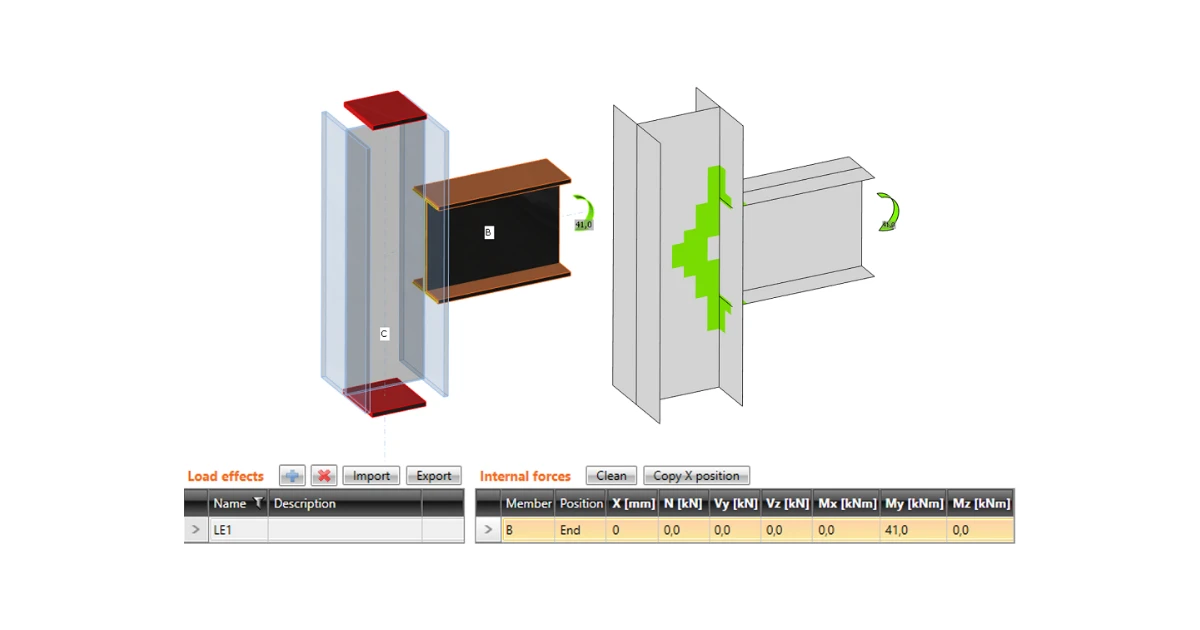
The difference between the modes is shown in the following example of T-connection. The beam is loaded by the end bending moment of 41ย kNm. There is also a compressive normal force of 100ย kN in the column. In the case of simplified mode, the normal force is not taken into account because the column is supported on both ends. The program shows only the effect of the bending moment of the beam. Effects of normal force are analyzed only in the full mode, and they are shown in the results.
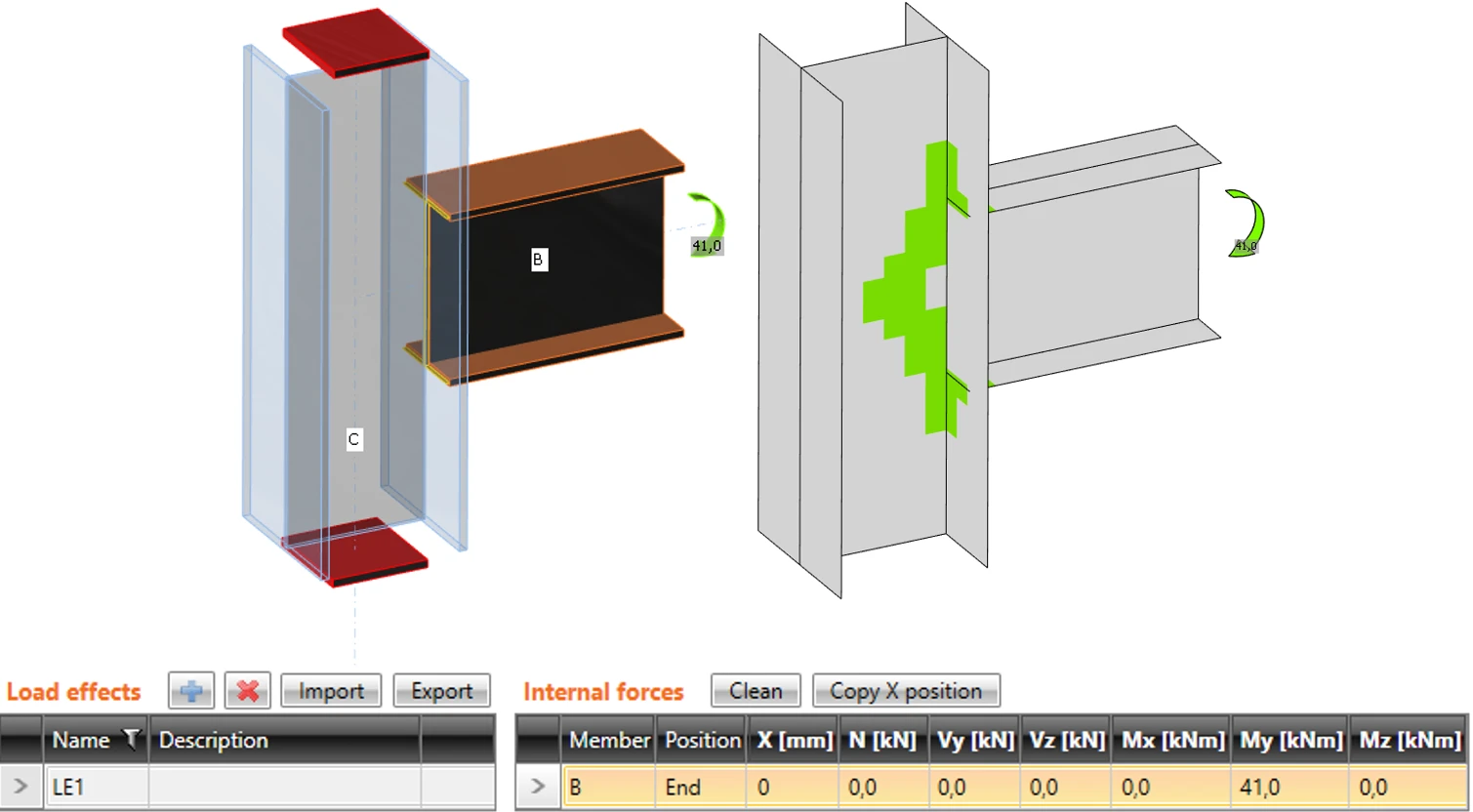
Simplified input: normal force in the column is NOT taken into account
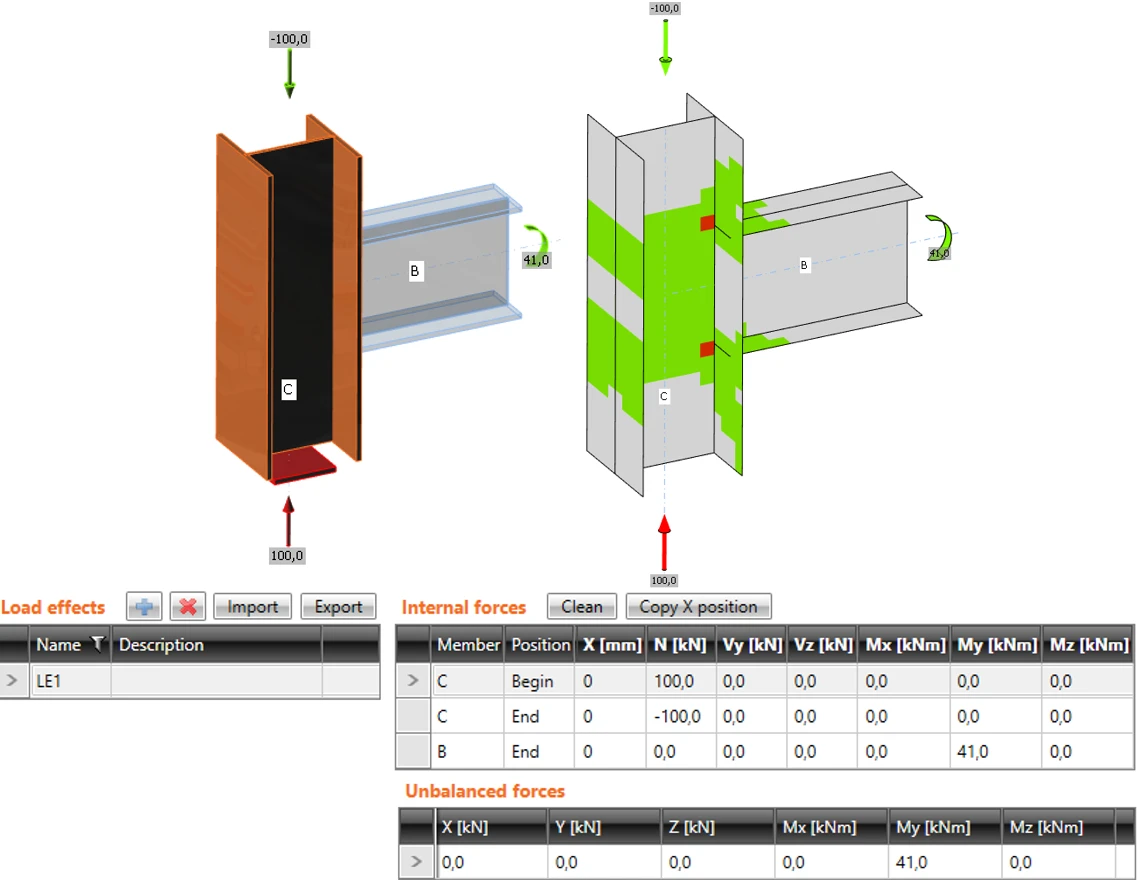
Advanced input: normal force in the column is taken into account

The simplified method is easier for the user, but it can be used only when the user is interested in studying connection items and not the behavior of the whole joint.

For cases where the bearing member is heavily loaded and close to its limit capacity, the advanced mode with respecting all the internal forces in the joint is necessary.
Related articles

Structural design of welded and bolted connections. The analysis model is generated automatically based on the inputs from manufacturing operations. IDEA StatiCa - structural analysis software.
  • Steel
  • Connection
  • AISC (USA)
  • AS (Australia)
  • CSA (Canada)
  • EN (Eurocode)
  • IS (India)
  • GB (China)
  • HKG (Hong Kong)
  • CBFEM
  • SP 16 (Russia)
  • +11
  • Steel
  • Connection
  • AISC (USA)
  • AS (Australia)
  • CSA (Canada)
  • EN (Eurocode)
  • IS (India)
  • GB (China)
  • HKG (Hong Kong)
  • CBFEM
  • SP 16 (Russia)

Knowledge base

Steel joint analysis model

Read more
The article is focusing on the internal forces in the steel connections. Structural design of welded and bolted connections. IDEA StatiCa - structural analysis software.
  • Steel
  • Connection
  • AISC (USA)
  • AS (Australia)
  • CSA (Canada)
  • EN (Eurocode)
  • IS (India)
  • GB (China)
  • HKG (Hong Kong)
  • Load effects
  • CBFEM
  • SP 16 (Russia)
  • +12
  • Steel
  • Connection
  • AISC (USA)
  • AS (Australia)
  • CSA (Canada)
  • EN (Eurocode)
  • IS (India)
  • GB (China)
  • HKG (Hong Kong)
  • Load effects
  • CBFEM
  • SP 16 (Russia)

Knowledge base

Internal forces in the steel connections

Read more
Different ways of load definition
  • Steel
  • Connection
  • Load effects
  • Moment Connection
  • Shear connection
  • +5
  • Steel
  • Connection
  • Load effects
  • Moment Connection
  • Shear connection

Knowledge base

Different ways to define load effects

Read more
Loads in equilibrium by default
  • Steel
  • Connection
  • AISC (USA)
  • EN (Eurocode)
  • Load effects
  • Equilibrium
  • +6
  • Steel
  • Connection
  • AISC (USA)
  • EN (Eurocode)
  • Load effects
  • Equilibrium

Knowledge base

Loads in equilibrium by default

Read more