Idea Statica
  • Steel
  • Concrete
  • BIM & Workflows
  • Support & Learning
  • Pricing
  • Company
  • Steel overview
  • Connection design
  • Member design
  • Parametric design
  • Steel case studies
  • Concrete overview
  • Walls and D-regions
  • Anchoring design
  • Concrete case studies
  • BIM Overview
  • Supported integrations
  • Checkbot
  • Viewer
  • APIs
  • Support Center
  • E-learning & certification
  • Blog
  • Downloads & Licensing
  • Plans
  • Free community tool
  • Enterprise customers
  • Students & educators
  • How much will you save?
  • About us
  • Contact
  • Research & development
  • Authorized resellers
  • Meet our customers
  • Career
  • Steel
    Steel overviewConnection designMember designParametric designSteel case studies
  • Concrete
    Concrete overviewWalls and D-regionsAnchoring designConcrete case studies
  • BIM & Workflows
    BIM OverviewSupported integrationsCheckbotViewerAPIs
  • Support & Learning
    Support CenterE-learning & certificationBlogDownloads & Licensing
  • Pricing
    PlansFree community toolEnterprise customersStudents & educatorsHow much will you save?
  • Company
    About usContactResearch & developmentAuthorized resellersMeet our customersCareer
14-Day Trial
14-Day Trial

Subscribe to our newsletter

Company

  • About us
  • Partners
  • Careers
  • Patent

Resources

  • Customer projects
  • Case studies
  • Connection Library
  • Verification books

Legal

  • EULA
  • Global privacy policy
  • California Privacy
  • TOS Viewer
  • Licensing

Help

  • Contact
  • Quote request
  • Resellers
  • Downloads
FacebookInstagramLinkedInYouTube

© IDEA StatiCa 2009-2026

Trusted and used worldwide by engineers, fabricators & consultants.

Support CenterKnowledge Base ArticlesCapacity design according to Chinese standard
Advanced analysis types for your steel structures
Seismic analysis in IDEA StatiCa Connection
Qualification checks of seismic prequalified connections for AISC
Prequalified Steel Connections (AISC) - Summary, Conclusion, and Recommendations
Steel connection capacity design
Capacity design (EN)
Capacity design (AISC)
Capacity design according to Canadian standards
Capacity design according to Australian standards
Capacity design according to Indian Standard
Capacity design according to Hong Kong Code
Capacity design according to Chinese standard
Capacity design according to Russian standards
Capacity design is a part of the seismic check and ensures that the joint has sufficient deformation capacity. IDEA StatiCa - engineering software for the structural design of steel connections and beams.
Connection designSteelKnowledge baseGB (China)Connection

Capacity design according to Chinese standard

This article is also available in
ENCZDEESFRITPTNLHUROKRPLTHTRVIZH

Capacity design is a part of seismic check and ensures that the joint has sufficient deformation capacity.

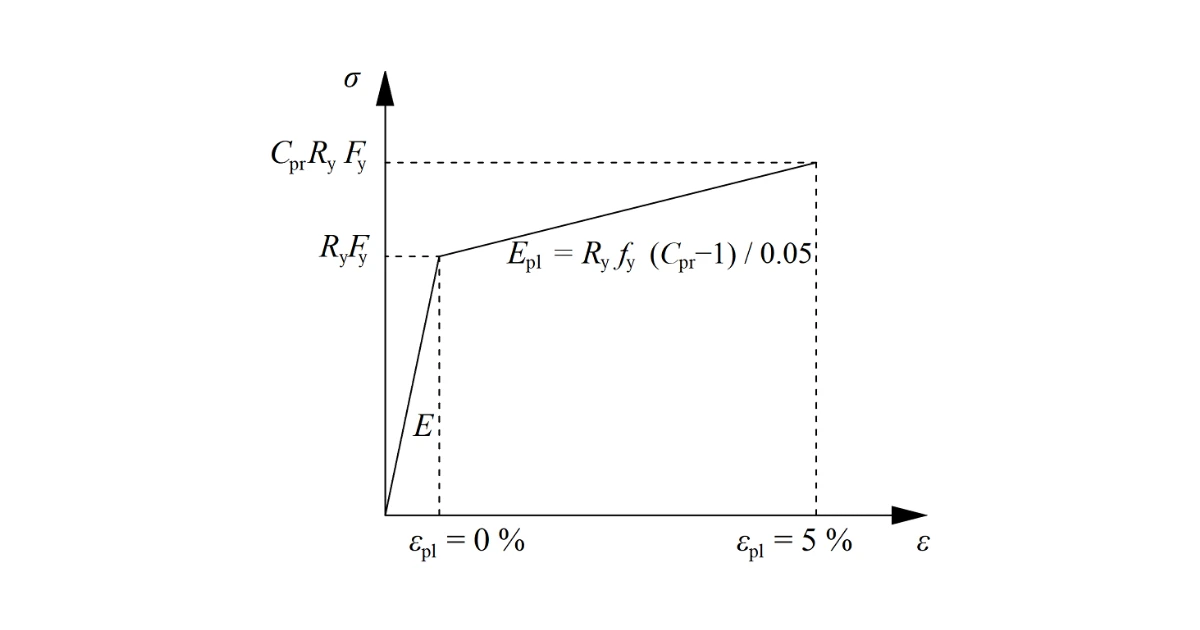
The connections must be able to safely transfer the force necessary to create a plastic hinge in a dissipative item. The dissipative item is selected by user alongside with the connection coefficient ηj taken from GB 50017-2017, Table 17.2.9. The connection coefficient ηj is divided between the overstrength factor γov and strain-hardening factor γsh; ηj = γovγsh. Strain-hardening factor γsh is defined by the user, and it is recommended as γsh = 1.1 for beam in moment resisting frame and γsh = 1.0 for other dissipative items. It is recommended to choose the safer ηj; e.g. ηj = 1.35 for the dissipative beam from steel grade Q345 in the moment resisting frame for the checks of both welds and bolts.

Connection coefficient ηj according to Table 17.2.9

Material diagram of the dissipative item
Related articles

CBFEM method combines the advantages of the general Finite Element Method and standard Component Method. Structural design of welded and bolted steel connections and steel beam to column connection details.
  • Steel
  • GB (China)
  • CBFEM
  • Connection
  • +4
  • Steel
  • GB (China)
  • CBFEM
  • Connection

Theoretical background

Check of steel connection components (GB)

Read more
The joints are classified according to rotational stiffness to rigid, semi-rigid, and pinned. The stiffness in the model should conform to the real joint stiffness. IDEA StatiCa - structural design of welded and bolted steel connections.
  • Steel
  • GB (China)
  • Connection
  • CBFEM
  • Rotational stiffness
  • Stiffness
  • +6
  • Steel
  • GB (China)
  • Connection
  • CBFEM
  • Rotational stiffness
  • Stiffness

Knowledge base

Joint classification according to Chinese standard

Read more
Capacity design analysis to deal with seismics
  • Steel
  • Connection
  • AISC (USA)
  • CBFEM
  • Capacity design
  • Moment Connection
  • Seismicity
  • EN (Eurocode)
  • +8
  • Steel
  • Connection
  • AISC (USA)
  • CBFEM
  • Capacity design
  • Moment Connection
  • Seismicity
  • EN (Eurocode)

Knowledge base

Seismic analysis in IDEA StatiCa Connection

Read more