Idea Statica
  • Steel
  • Concrete
  • Support & Learning
  • Pricing
  • Company
  • Steel overview
  • Connection design
  • Member design
  • Parametric design
  • Steel case studies
  • Concrete overview
  • Walls and D-regions
  • Anchoring design
  • Concrete case studies
  • BIM Overview
  • Supported integrations
  • Checkbot
  • Viewer
  • APIs
  • Support Center
  • E-learning & certification
  • Blog
  • Downloads & Licensing
  • Plans
  • Free community tool
  • Enterprise customers
  • Students & educators
  • How much will you save?
  • About us
  • Contact
  • Research & development
  • Authorized resellers
  • Meet our customers
  • Career
  • Steel
    Steel overviewConnection designMember designParametric designSteel case studies
  • Concrete
    Concrete overviewWalls and D-regionsAnchoring designConcrete case studies
  • BIM OverviewSupported integrationsCheckbotViewerAPIs
  • Support & Learning
    Support CenterE-learning & certificationBlogDownloads & Licensing
  • Pricing
    PlansFree community toolEnterprise customersStudents & educatorsHow much will you save?
  • Company
    About usContactResearch & developmentAuthorized resellersMeet our customersCareer
14-Day Trial
14-Day Trial

Subscribe to our newsletter

Company

  • About us
  • Partners
  • Careers
  • Patent

Resources

  • Customer projects
  • Case studies
  • Connection Library
  • Verification books

Legal

  • EULA
  • Privacy policy
  • California Privacy
  • TOS Viewer
  • Licensing

Help

  • Contact
  • Quote request
  • Resellers
  • Downloads
FacebookInstagramLinkedInYouTube

© IDEA StatiCa 2009-2026

Trusted and used worldwide by engineers, fabricators & consultants.

Support CenterKnowledge Base ArticlesCode-check of bolts and preloaded bolts according to Russian standards
Advanced analysis types for your steel structures
Bolts are too close to plate edge
Traffic lights for forces in bolts
Prying and high tension force in bolts
Bolt force distribution in end-plate beam-to-column connection
Bolt shear force calculated per shear plane
Bolt bearing distances for Eurocode
Warnings for welds and bolts connecting the same plates
Slip resistance check update according to SP 16
Detailing improvements for bolts and welds in Eurocode
Angle to the grain of the steel-to-timber connections
Filler plate (packing plate) recognition
Code-check of bolts and preloaded bolts (EN)
Code-check of bolts and preloaded bolts (AISC)
Code-check of bolts and preloaded bolts according to Canadian standards
Code-check of bolts and preloaded bolts according to Australian standards
Code-check of bolts and preloaded bolts according to Chinese standard
Code-check of bolts according to Hong Kong Code
Code-check of bolts and preloaded bolts according to Hong Kong Code
Code-check of bolts according to Indian standard
Code-check of preloaded bolts according to Indian standards
Code-check of bolts and preloaded bolts according to Russian standards
The forces in bolts, including prying forces, are determined by finite element analysis. The bolt resistances are checked by code provisions. Structural design of bolted steel connections.
SteelKnowledge baseConnectionCBFEMBolts

Code-check of bolts and preloaded bolts according to Russian standards

This article is also available in
ENCZDEESFRITPTNLHUROKRPLTHTRVIZH

Bolts

Bolts are checked according to SP 16, Cl. 14.2. The tensile and shear force in each bolt is determined by finite element analysis. Prying forces are determined by finite element analysis and taken into account. Each shear plane is checked individually. Ply in bearing is checked against the sum of shear forces at nearby planes.

Bolt in shear

A bolt subject to a design shear force is designed according to Cl. 14.2.9 and shall satisfy:

Ns≤Nbs=RbsAbγbγcN_s \le N_{bs} = R_{bs} A_b \gamma_b \gamma_cNs​≤Nbs​=Rbs​Ab​γb​γc​

where:

  • Ns – shear force in one plane of a bolt
  • Nbs – bolt shear resistance
  • Rbs – design shear strength of a bolt – SP 16, Table 5
  • Ab – bolt gross section area
  • γb – service factor of bolt joint – SP 16, Table 41 – γb = 1.0 for single bolting and multibolting with accuracy class A, γb = 0.9 for multibolting and accuracy class B and high strength bolts (Rbun ≥ 800 MPa)
  • γc – service factor – SP 16, Table 1, editable in Code setup
Rbyn [MPa]Rbs [MPa]
Rbyn≤300R_{byn} \le 300Rbyn​≤3000.42⋅Rbun0.42 \cdot R_{bun}0.42⋅Rbun​
300<Rbyn≤400300 < R_{byn} \le 400300<Rbyn​≤4000.41⋅Rbun0.41 \cdot R_{bun}0.41⋅Rbun​
400<Rbyn≤936400 < R_{byn} \le 936400<Rbyn​≤9360.40⋅Rbun0.40 \cdot R_{bun}0.40⋅Rbun​
936>Rbyn936 > R_{byn}936>Rbyn​0.35⋅Rbun0.35 \cdot R_{bun}0.35⋅Rbun​

Each shear plane is checked individually.

Bolt in tension

A bolt subject to design tension force is designed according to SP 16, Cl. 14.2.9 and shall satisfy:

Nt≤Nbt=RbtAbnγcN_t ≤ N_{bt} = R_{bt} A_{bn} \gamma_cNt​≤Nbt​=Rbt​Abn​γc​

where:

  • Nt – tensile force in a bolt
  • Nbt – bolt tensile resistance
  • Rbt – design tensile strength – SP 16, Table 5
  • Abn – net cross-sectional area of a bolt
  • γc – service factor – SP 16, Table 1, editable in Code setup
Rbun [MPa]Rbt [MPa]
Rbun<830R_{bun} < 830Rbun​<8300.45⋅Rbun0.45 \cdot R_{bun}0.45⋅Rbun​
830≤Rbun<1040830 \le R_{bun} < 1040830≤Rbun​<10400.54⋅Rbun0.54 \cdot R_{bun}0.54⋅Rbun​
Rbun≥1040R_{bun} \ge 1040Rbun​≥10400.70⋅Rbun0.70 \cdot R_{bun}0.70⋅Rbun​

Bolt subject to combined shear and tension

A bolt loaded in shear and tensile forces at the same time is designed according to SP 16, Cl. 14.2.13 and shall satisfy:

(NtNbt)2+(NsNbs)2≤1.0\sqrt{\left ( \frac{N_t}{N_{bt}} \right ) ^2 + \left ( \frac{N_s}{N_{bs}} \right ) ^2} \le 1.0(Nbt​Nt​​)2+(Nbs​Ns​​)2​≤1.0

where:

  • Nt – tensile force in a bolt
  • Nbt – bolt tensile resistance
  • Ns – shear force in one plane of a bolt
  • Nbs – bolt shear resistance

Bolts in bearing

A plate subject to a bearing force due to a bolt in shear is designed according to SP 16, Cl. 14.2.9 and shall satisfy:

Ns≤Nbp=RbpdbtγbγcN_s ≤ N_{bp} = R_{bp} d_b t \gamma_b \gamma_cNs​≤Nbp​=Rbp​db​tγb​γc​

where:

  • Ns – shear force in a bolt acting on a ply
  • Nbp – bearing resistance of a ply
  • Rbp – bearing design strength; Rbp = 1.6 · Ru for accuracy class A and Rbp = 1.35 · Ru for accuracy class B – SP 16, Table 5
  • Run – ultimate strength of the connected element
  • db – bolt diameter
  • t – thickness of the plate
  • γb – service factor of bolt joint – SP 16, Table 41
  • γc – service factor – SP 16, Table 1, editable in Code setup

Each plate is checked individually and the worst case is shown. SP 16 does not show the service factor of bolted connection, γb for cases outside detailing limits. Therefore, the bearing check is not performed for such cases.

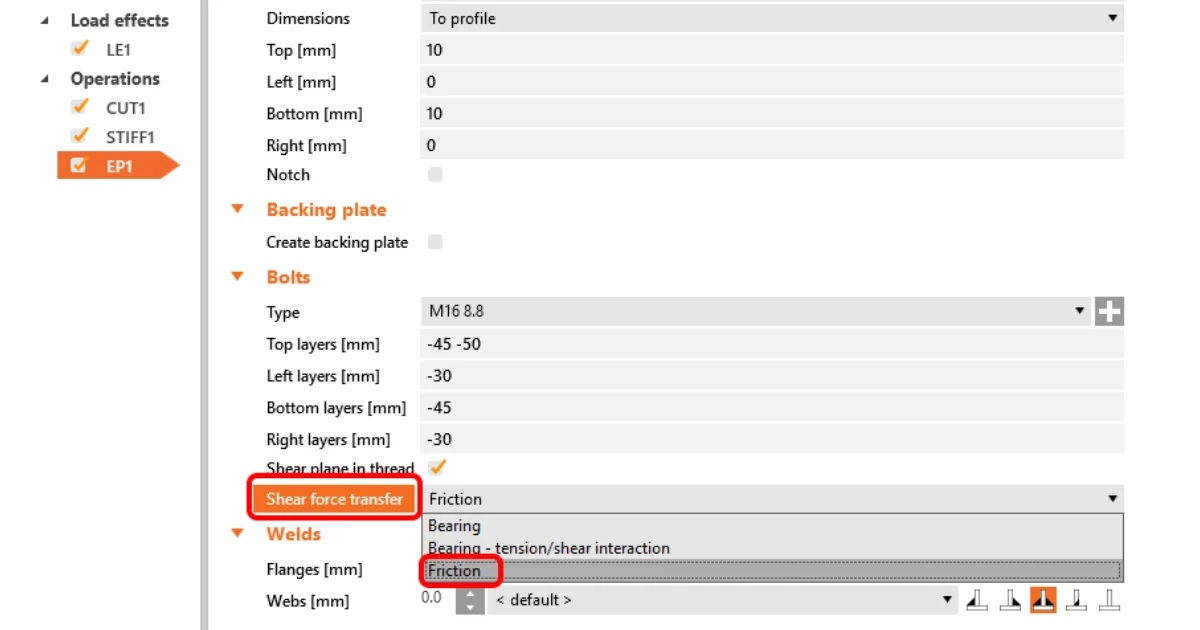
Friction-type connections

For friction-type connections, the slip is required to be limited and checked according to SP 16, Cl. 14.3. These bolts should be also checked as bearing type for ultimate limit state after slip occurs. A bolt subjected to shear force shall satisfy:

Ns≤Nbf=QbhγbγcN_s \le N_{bf} = Q_{bh} \gamma_b \gamma_cNs​≤Nbf​=Qbh​γb​γc​

where:

  • Ns – shear force acting on one preloaded bolt and one friction plane
  • Nbf – shear slip resistance of one preloaded bolt and one friction plane
  • Qbh = Rbh Abn μ / γh – design slip resistance of one preloaded bolt and one friction plane
  • Rbh = 0.7 · Rbun – design preload in the preloaded bolt – SP 16, Cl. 6.7
  • Rbun – ultimate tensile resistance of the bolt
  • Abn – tensile stress area
  • μ – frictional coefficient for preloaded bolts – SP 16, Table 42, editable in Code setup
  • γh – coefficient in case of bolt tightening – SP 16, Table 42
    • Regular holes: static loading, Δ ≤ 4 mm; dynamic loading, Δ ≤ 1 mm:
      • γh = 1.12 for μ ≥ 0.42
      • γh = 1.17 for 0.35 ≤ μ < 0.42
      • γh = 1.30 for μ < 0.35
    • Oversized holes: static loading, Δ > 4 mm; dynamic loading, Δ > 1 mm:
      • γh = 1.70 for μ < 0.35
      • γh = 1.35 for μ ≥ 0.35
  • Δ – difference between diameters of bolt hole and of bolt
  • γb – friction joint service factor – SP 16, Cl. 14.3.4
  • γc – service factor – SP 16, Table 1, editable in Code setup

Static or dynamic loading can be set in Code setup.

Number of bolts nγb\gamma_bγb​
n<5n < 5n<50.8
5≤n<105 \le n < 105≤n<10 0.9
n≥10n \ge 10n≥10 1.0

Number of effective interfaces, κ, is always equal to 1, because each interface is checked separately.

According to SP 16, Cl. 14.3.6, for bolts in friction-type connections loaded by combined shear and tension, friction joint service factor, γb, is multiplied by:

γb=γb⋅(1−NtPb)\gamma_b = \gamma_b \cdot \left ( 1 - \frac{N_t}{P_b} \right )γb​=γb​⋅(1−Pb​Nt​​)

where:

  • Nt – tensile force in a bolt
  • Pb = Rbh Abn – preload in a bolt
  • Rbh = 0.7 · Rbun – design preload in the preloaded bolt – SP 16, Cl. 6.7
  • Abn – tensile stress area

Friction-type connections should be also checked for ultimate limit state. The bolt type should be changed to bearing – tension/shear interaction, the loads increased appropriately and the joint should be checked again.
Related articles

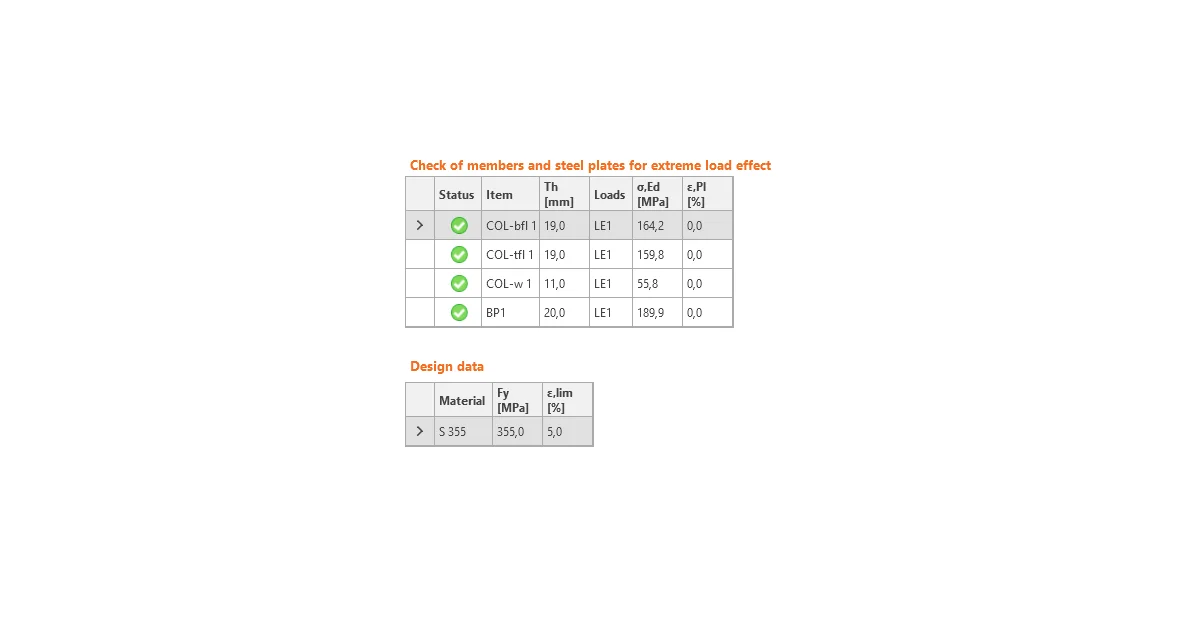
Strain check is performed at shell finite elements simulating plates. IDEA StatiCa - structural analysis software for steel member design.
  • Steel
  • Connection
  • CBFEM
  • Plates
  • SP 16 (Russia)
  • +5
  • Steel
  • Connection
  • CBFEM
  • Plates
  • SP 16 (Russia)

Knowledge base

Code-check of steel plates according to Russian standards

Read more
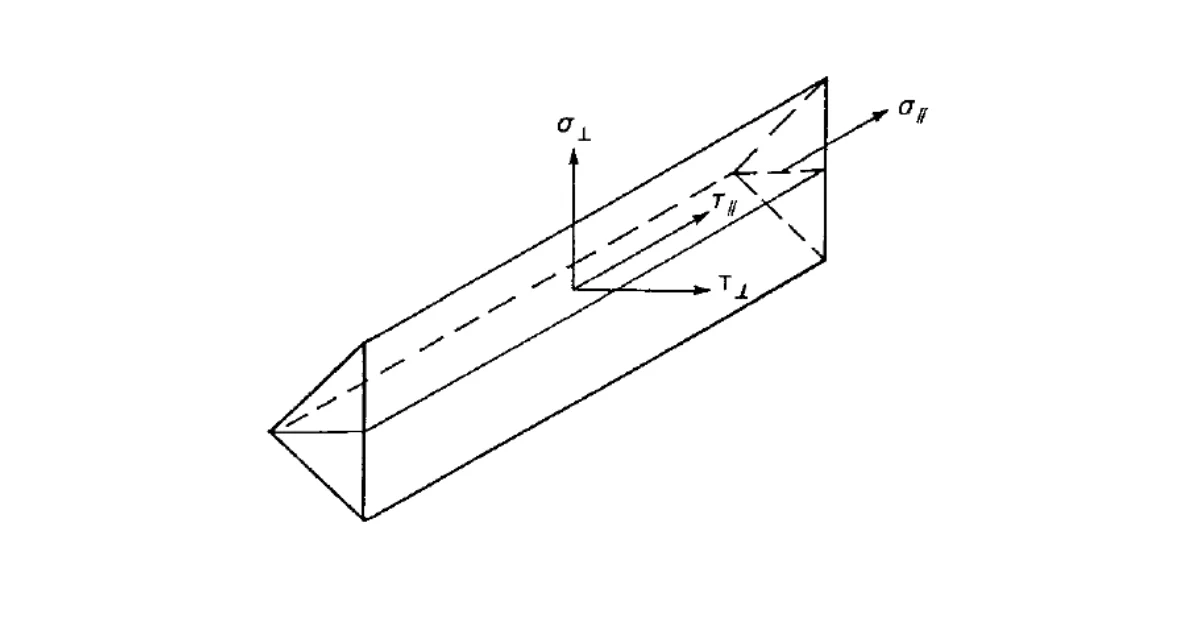
Fillet welds are checked according to SP 16. The strength of butt welds is assumed the same as the base metal and is not checked. Structural design of welded steel connections and steel beam to column connection details.
  • Steel
  • Connection
  • CBFEM
  • Welds
  • SP 16 (Russia)
  • +5
  • Steel
  • Connection
  • CBFEM
  • Welds
  • SP 16 (Russia)

Knowledge base

Code-check of welds according to Russian standards

Read more
How to define pre-loaded bolts
  • Steel
  • Connection
  • AISC (USA)
  • Bolts
  • Contacts
  • EN (Eurocode)
  • +6
  • Steel
  • Connection
  • AISC (USA)
  • Bolts
  • Contacts
  • EN (Eurocode)

Knowledge base

How to define preloaded bolts

Read more
Workflows for preloaded bolts
  • Steel
  • SLS
  • Connection
  • Bolts
  • +4
  • Steel
  • SLS
  • Connection
  • Bolts

Webinar

Summer Series - Workflows for preloaded bolts

Read more