Idea Statica
  • Steel
  • Concrete
  • BIM & Workflows
  • Support & Learning
  • Pricing
  • Company
  • Steel overview
  • Connection design
  • Member design
  • Parametric design
  • Steel case studies
  • Concrete overview
  • Walls and D-regions
  • Anchoring design
  • Concrete case studies
  • BIM Overview
  • Supported integrations
  • Checkbot
  • Viewer
  • APIs
  • Support Center
  • E-learning & certification
  • Blog
  • Downloads & Licensing
  • Plans
  • Free community tool
  • Enterprise customers
  • Students & educators
  • How much will you save?
  • About us
  • Contact
  • Research & development
  • Authorized resellers
  • Meet our customers
  • Career
  • Steel
    Steel overviewConnection designMember designParametric designSteel case studies
  • Concrete
    Concrete overviewWalls and D-regionsAnchoring designConcrete case studies
  • BIM & Workflows
    BIM OverviewSupported integrationsCheckbotViewerAPIs
  • Support & Learning
    Support CenterE-learning & certificationBlogDownloads & Licensing
  • Pricing
    PlansFree community toolEnterprise customersStudents & educatorsHow much will you save?
  • Company
    About usContactResearch & developmentAuthorized resellersMeet our customersCareer
14-Day Trial
14-Day Trial
  • Steel
  • Concrete
  • BIM & Workflows
  • Support & Learning
  • Pricing
  • Company

Subscribe to our newsletter

Company

  • About us
  • Partners
  • Careers
  • Patent

Resources

  • Customer projects
  • Case studies
  • Connection Library
  • Verification books

Legal

  • EULA
  • Privacy policy
  • California Privacy
  • TOS Viewer
  • Licensing

Help

  • Contact
  • Quote request
  • Resellers
  • Downloads
FacebookInstagramLinkedInYouTube

ยฉ IDEA StatiCa 2009-2026

Trusted and used worldwide by engineers, fabricators & consultants.

Support CenterKnowledge Base ArticlesTypes of supports in IDEA StatiCa Detail
Supports in IDEA StatiCa Detail - Advanced Topics
Types of supports in IDEA StatiCa Detail
Partially loaded areas
Export Beam to Detail
Export of the beam to Detail app
Types of supports in IDEA StatiCa Detail
ConcreteReinforced concretePrestressed concreteKnowledge baseDetail 2D

Types of supports in IDEA StatiCa Detail

This article is also available in
ENCZDEESFRITPTNLHUROKRPLTHTRVIZH

Boundary conditions definition is always a tricky task when modeling the structure in FEA software. The model with only properly defined supports can capture reality.

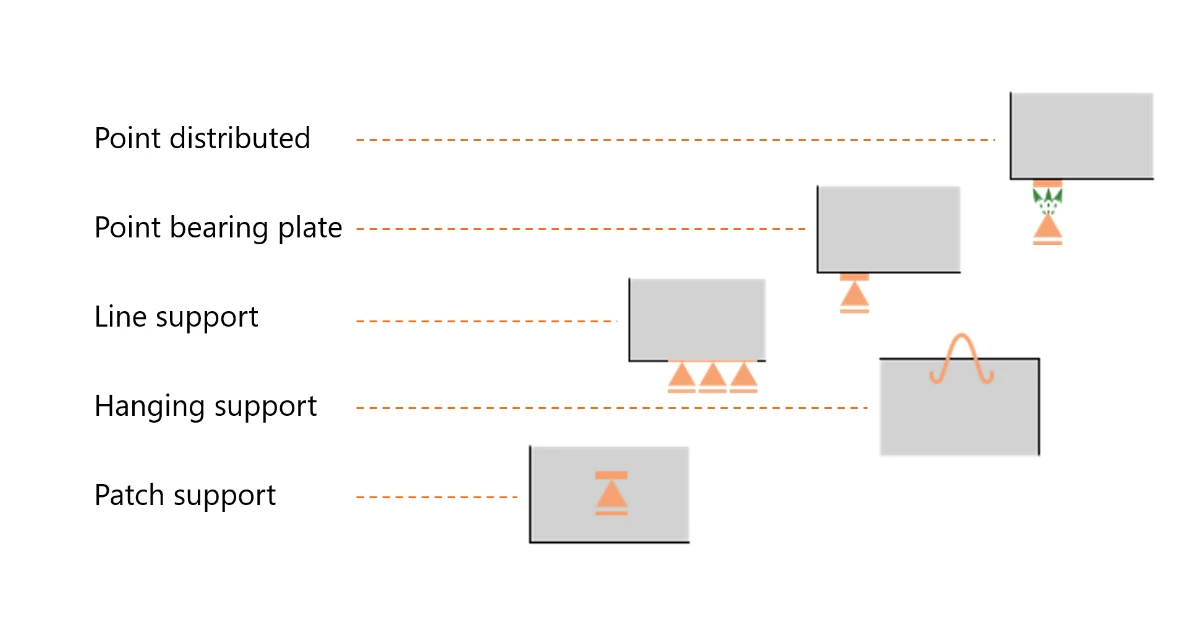
You will find out how to apply boundary conditions in the application IDEA StatiCa Detail which uses the CSFM (Compatible stress field method). There are five types of supports, let's find out what are they for.

Supports in IDEA StatiCa Detail

Point Distributed Support

The first type of support is point distributed support which is defined on the edge or within an area of the model where the reaction is distributed.ย Due to distribution, the stress is not concentrated at one point but distributed over an area. No abrupt changes of stress occur. This type of support is perfect where rotation is enabled, and the stress distribution is uniform under the support, especially elastomeric and pot bridge bearings. Check out the functionality ofย partially loaded areasย which is compatible only with point-distributed support.
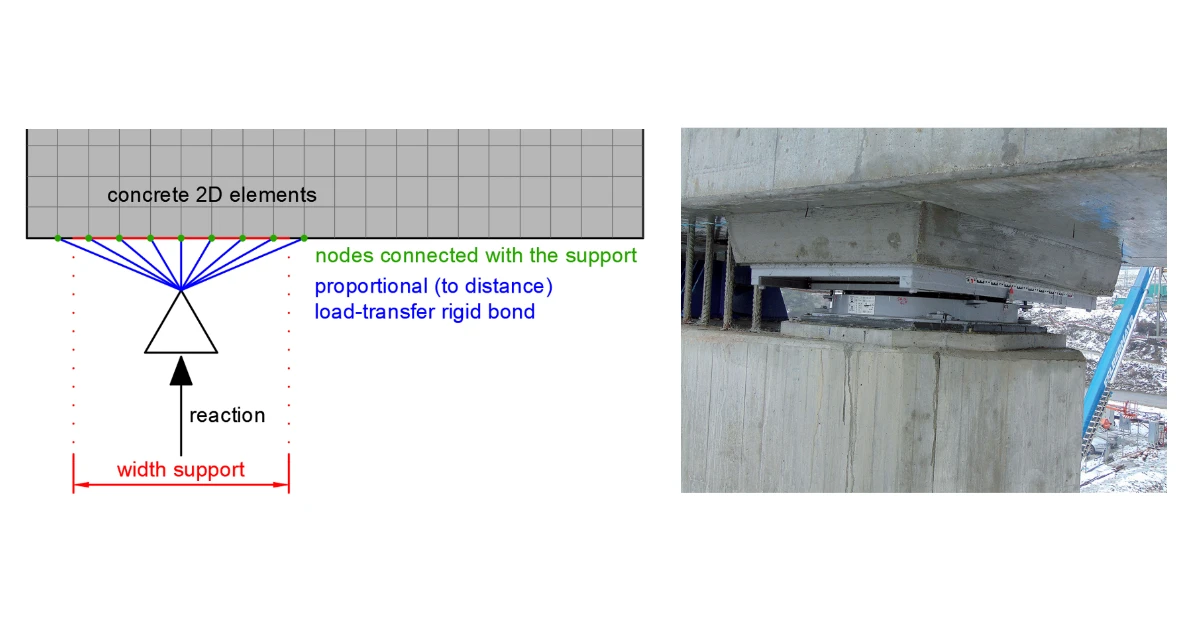
Point distributed support

Bearing Plate Support

The second type of support is called bearing plate support. A point reaction is transferred to the model via a steel plate where the plate is not checked, and it serves as a reaction transfer device.ย The steel plate prevents the occurrence of cracks in concrete and deforms. The dimensions of the plate may affect the results significantly. This kind of support is perfect for structures where a real steel plate is, such as roller bridge bearing.
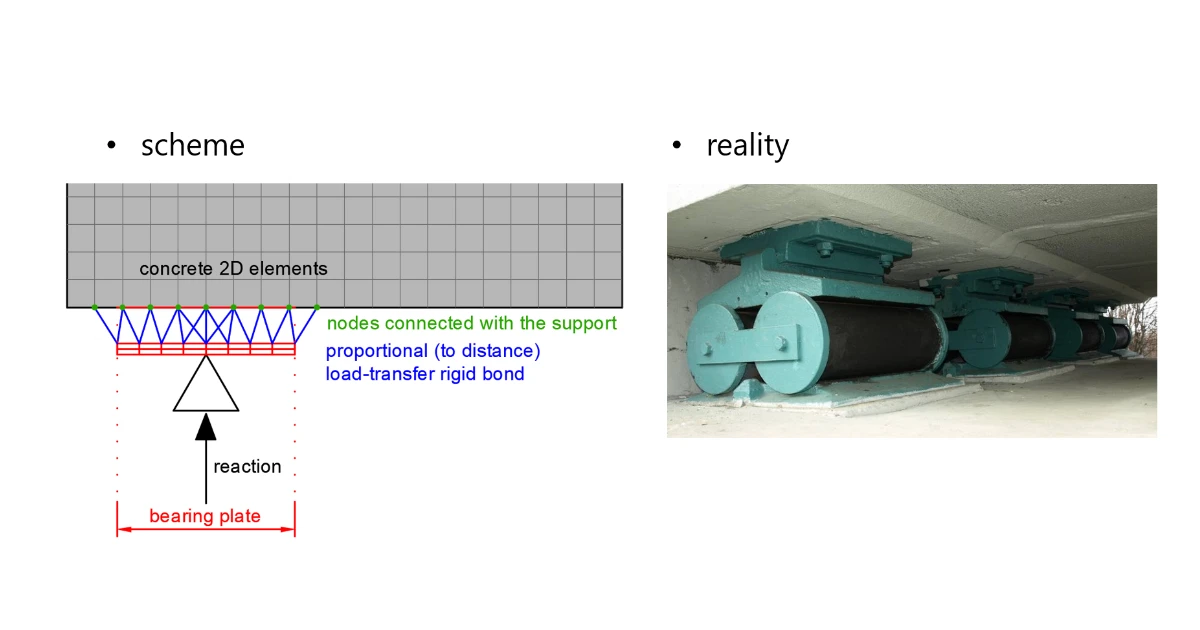
Bearing plate support

Line Support

The third type of support, which can be considered as universal or more general than these two previous ones, is called line support. It acts as a group of spring supports within a defined length on the edge or area of the model. Spring stiffness is either default (corresponding to the structure stiffness above the support) or defined by the user. There is a possibility of modeling non-linear support acting in compression only. This kind of support is perfect for any support which does not fit to assumptions of the first two supports (point distributed,ย bearing plate), especially line supports and spring supports of the piles acting in compression only.
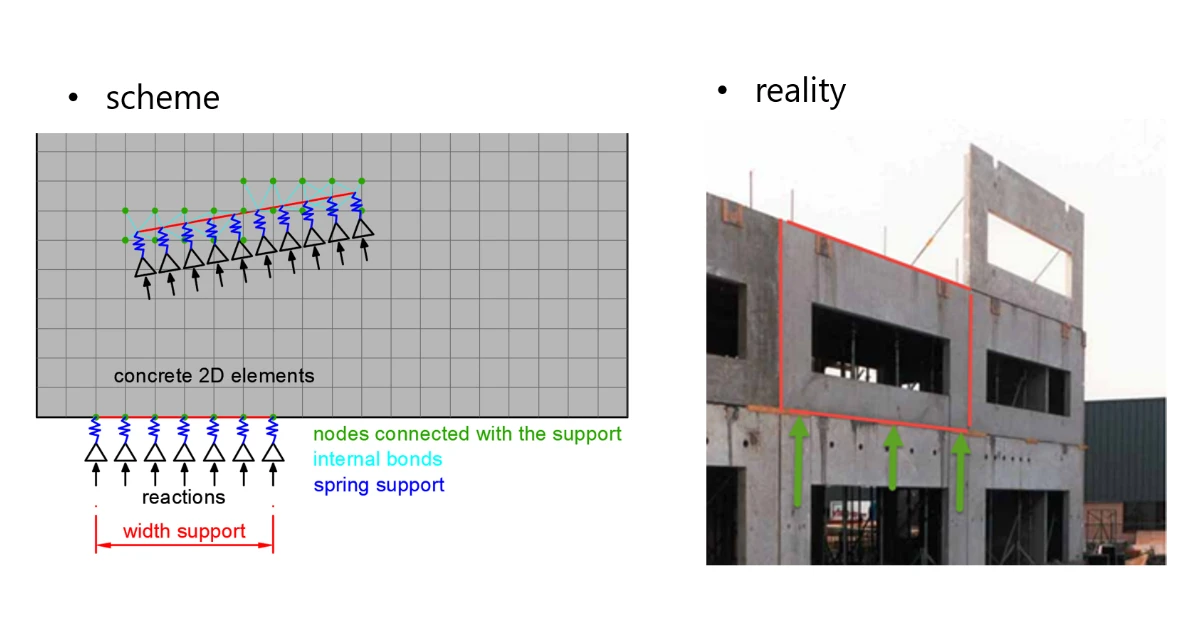
Line support

Hanging Support

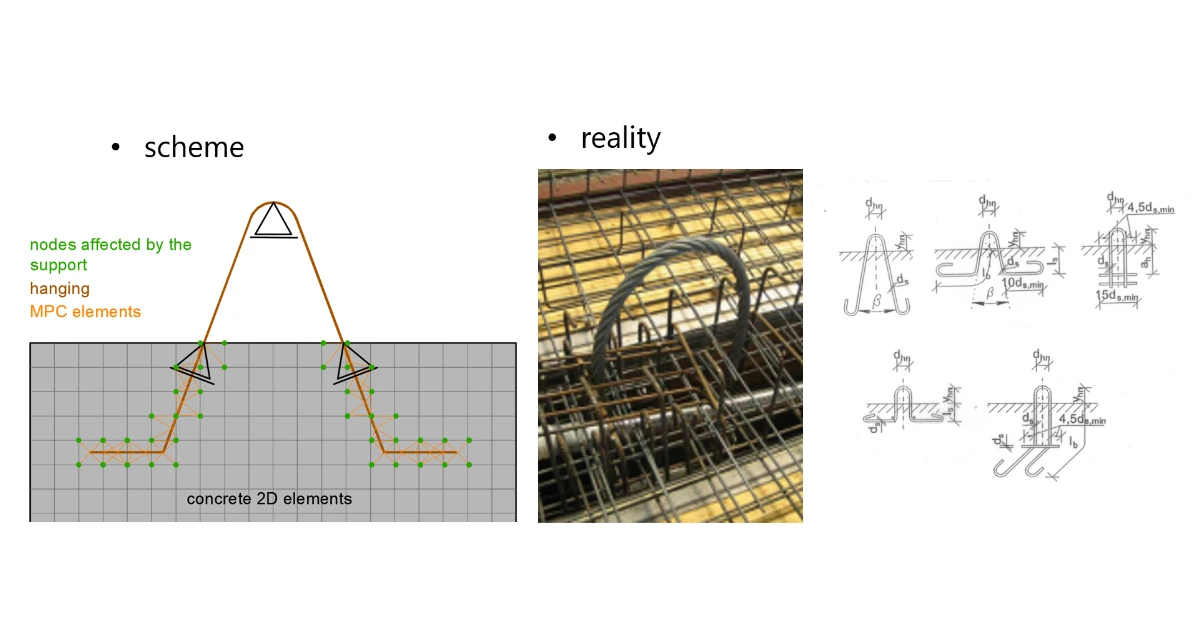
The fourth type of support is the hanging support. The support applied at the hanging is converted, according to the rotation, to the supports acting in the axes of each hanging branch, applied at the point where the hanging branches enter the concrete.ย The part of the hanging protruding from the concrete is not checked. The utilization of such support is quite obvious โ€“ precast concrete lifting anchor system, especially the site operational loop made from reinforcing steel.ย 

Hanging support

Patch Support

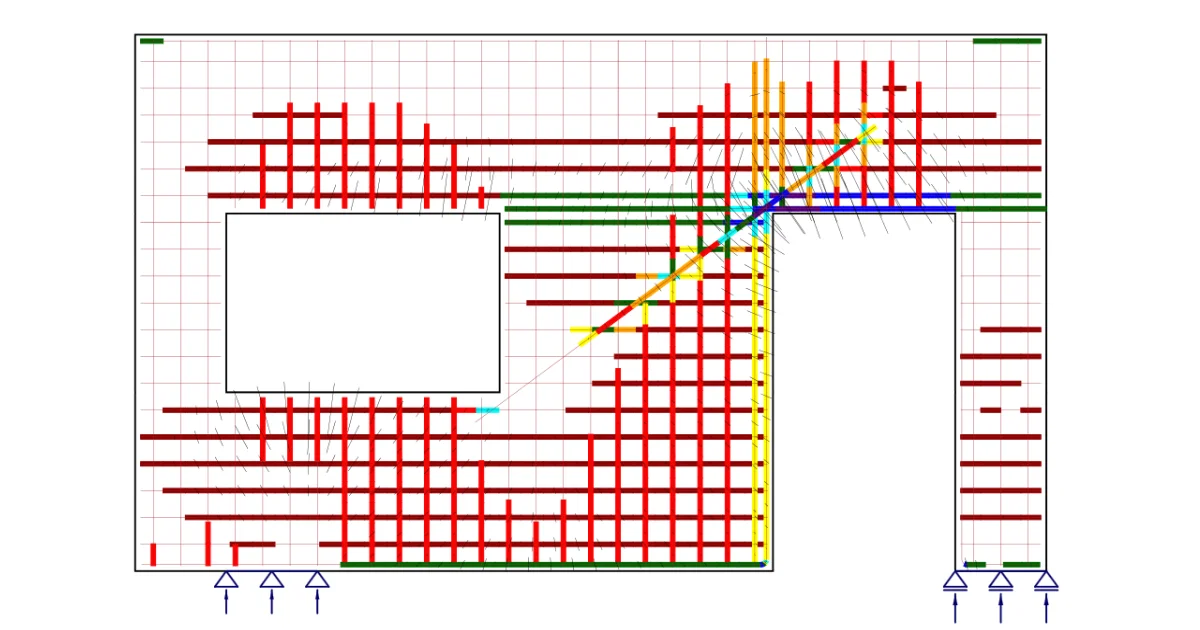
The fifth type of support in IDEA StatiCa Detail is patch support. It is a point support with a specific area through which the reaction is transferred to the model. The reaction is applied directly to reinforcement, explicitly specified (otherwise, it is applied to a concrete). The utilization of such support is quite obvious โ€“ precast concrete lifting anchor system, especially steel plate welded to reinforcement, basically all kinds of lifting anchor systems fastened (welded) to reinforcement or supported the anchor against it. Another use of this support is the modeling of the bearing of the ledge beam (indirect support system).
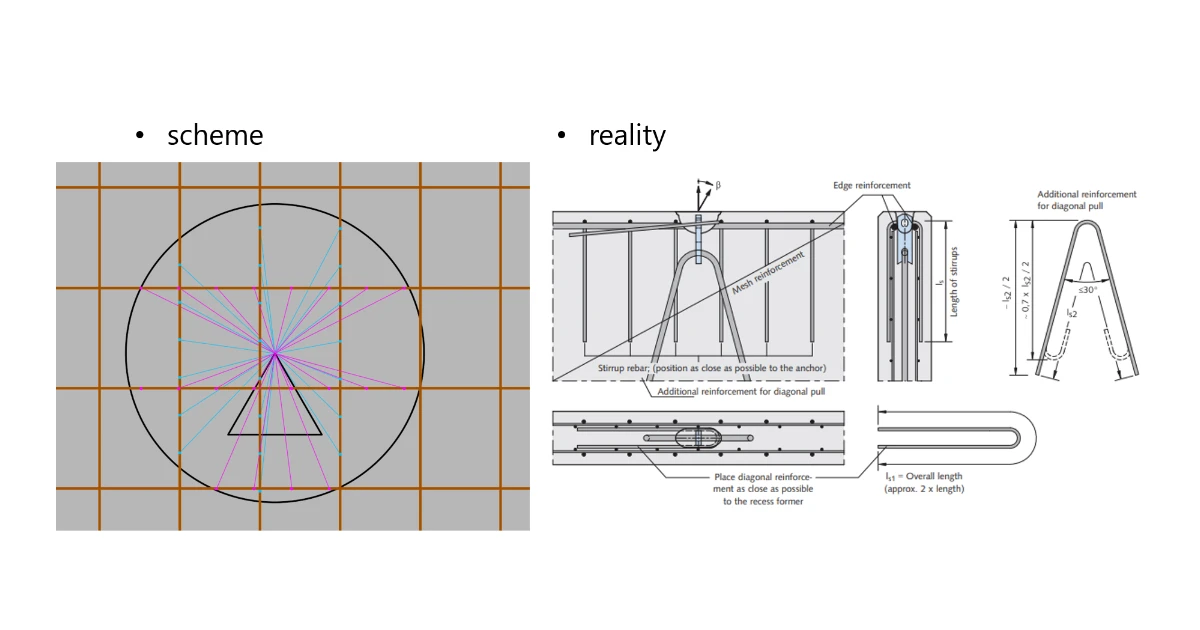
Patch support

For a more demonstrative explanation, check the webinar, where all the types of support are explained one by one:

ย Tip for advanced users

In the previous article, we covered the basic types of supports applicable in IDEA StatiCa Detail. However, it may happen that for specific structures, these basic types are not sufficient.

We have prepared an article focusing on specific, more advanced topics relevant to anchors, bridge bearings, etc.: Supports in IDEA StatiCa Detail - Advanced Topics
Related articles

IDEA StatiCa Detail is concrete design software for the structural design and code-check of concrete discontinuity regions. Concrete members stress analysis & concrete wall design.
  • Concrete
  • ACI (USA)
  • EN (Eurocode)
  • Geometry
  • Load effects
  • Overall check
  • Material settings
  • Corbels/Brackets
  • CSFM
  • Cracks
  • Deflections
  • Diaphragms
  • Openings
  • SLS
  • Stress in reinforcement
  • TDA
  • Topology optimization
  • ULS
  • Detail 2D
  • +19
  • Concrete
  • ACI (USA)
  • EN (Eurocode)
  • Geometry
  • Load effects
  • Overall check
  • Material settings
  • Corbels/Brackets
  • CSFM
  • Cracks
  • Deflections
  • Diaphragms
  • Openings
  • SLS
  • Stress in reinforcement
  • TDA
  • Topology optimization
  • ULS
  • Detail 2D

Theoretical background

IDEA StatiCa Detail โ€“ Structural design of concrete discontinuities

Read more
Supports in IDEA StatiCa Detail
  • Concrete
  • Detail 2D
  • Bridges
  • CSFM
  • Pier caps
  • +5
  • Concrete
  • Detail 2D
  • Bridges
  • CSFM
  • Pier caps

Knowledge base

Supports in IDEA StatiCa Detail - Advanced Topics
Read more
Basic assumptions of Compatible stress field method (CSFM)
  • Concrete
  • ACI (USA)
  • EN (Eurocode)
  • CSFM
  • Cracks
  • Stress in reinforcement
  • Detail 2D
  • +7
  • Concrete
  • ACI (USA)
  • EN (Eurocode)
  • CSFM
  • Cracks
  • Stress in reinforcement
  • Detail 2D

Knowledge base

Basic assumptions of Compatible Stress Field Method (CSFM)

Read more