Idea Statica
  • Steel
  • Concrete
  • Support & Learning
  • Pricing
  • Company
  • Steel overview
  • Connection design
  • Member design
  • Parametric design
  • Steel case studies
  • Concrete overview
  • Walls and D-regions
  • Anchoring design
  • Concrete case studies
  • BIM Overview
  • Supported integrations
  • Checkbot
  • Viewer
  • APIs
  • Support Center
  • E-learning & certification
  • Blog
  • Downloads & Licensing
  • Plans
  • Free community tool
  • Enterprise customers
  • Students & educators
  • How much will you save?
  • About us
  • Contact
  • Research & development
  • Authorized resellers
  • Meet our customers
  • Career
  • Steel
    Steel overviewConnection designMember designParametric designSteel case studies
  • Concrete
    Concrete overviewWalls and D-regionsAnchoring designConcrete case studies
  • BIM OverviewSupported integrationsCheckbotViewerAPIs
  • Support & Learning
    Support CenterE-learning & certificationBlogDownloads & Licensing
  • Pricing
    PlansFree community toolEnterprise customersStudents & educatorsHow much will you save?
  • Company
    About usContactResearch & developmentAuthorized resellersMeet our customersCareer
14-Day Trial
14-Day Trial

Subscribe to our newsletter

Company

  • About us
  • Partners
  • Careers
  • Patent

Resources

  • Customer projects
  • Case studies
  • Connection Library
  • Verification books

Legal

  • EULA
  • Privacy policy
  • California Privacy
  • TOS Viewer
  • Licensing

Help

  • Contact
  • Quote request
  • Resellers
  • Downloads
FacebookInstagramLinkedInYouTube

© IDEA StatiCa 2009-2026

Trusted and used worldwide by engineers, fabricators & consultants.

Support CenterKnowledge Base ArticlesSingularity detection in Member
IDEA StatiCa Member for steel
Why is 5% plastic strain limit used in material diagram for EN?
Why is 5% plastic strain limit used in material diagram for AISC?
Member analysis - Interpretation of MNA and GMNIA results
How to input imperfections in Member
Singularity detection in Member
What is the singularity warning?
3D visualization of deformations
Smooth results with precise meshing
Singularity detection in Member
SteelMember designKnowledge baseMemberGeometry

Singularity detection in Member

This article is also available in
ENCZDEESFRITPTNLHUROKRPLTHTRVIZH

Due to modeling mistakes, there might be unconnected or unsupported parts of the structural model that cause singularity. Member now gives a description of which part is creating the problem.

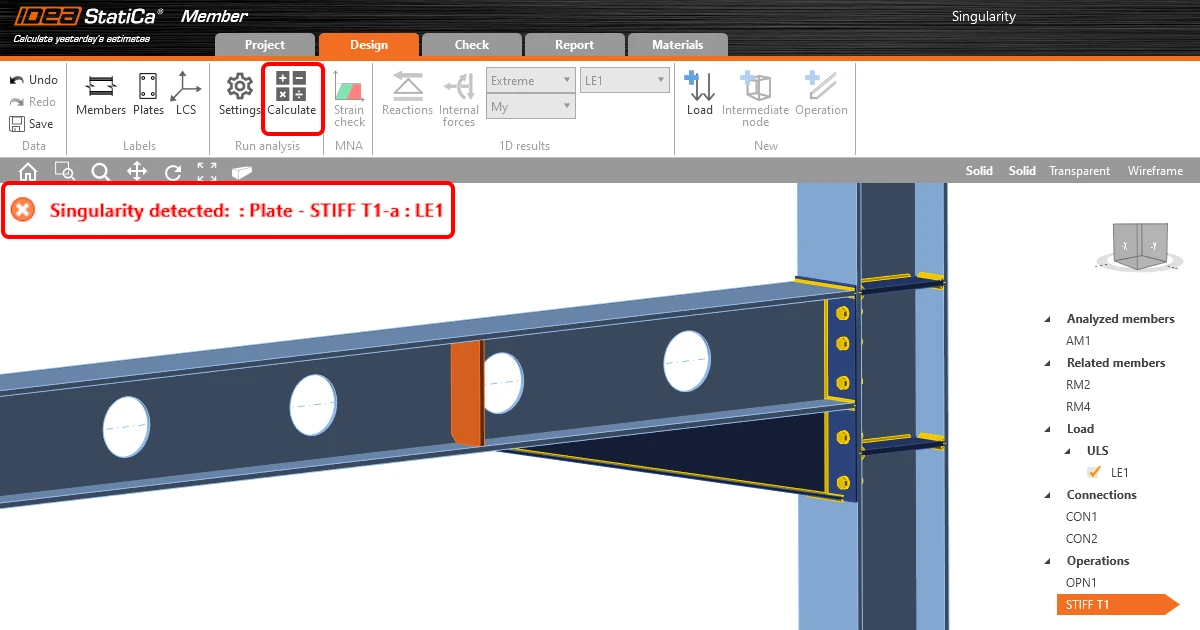
If the model of Member is imperfect in terms of modeling (e.g., a stiffener plate is not welded to the beam or some connection is missing), the singularity message will appear after pushing the Calculate button, and the analysis is stopped.

This was a problem, especially in large Member models where it was difficult to identify which part of the model caused the singularity.

With the new version, the message with the description of the problematic part is shown in the 3D window, and the missing connection can be easily fixed. In case there are more singularities, the first failing part is shown, and after it is fixed, the other is revealed.

Available in IDEA StatiCa Steel.
Download the new version of IDEA StatiCa and try all the features

Download new version

Related articles

Member model organization
  • Steel
  • Member
  • Geometry
  • CBFEM
  • Modeling
  • +5
  • Steel
  • Member
  • Geometry
  • CBFEM
  • Modeling

Knowledge base

Member model organization

Read more
By following this step-by-step tutorial, you will learn how to make the structural design of a steel frame using IDEA StatiCa Member. An example is an anchored frame with an inclined column.
  • Steel
  • Member
  • EN (Eurocode)
  • +3
  • Steel
  • Member
  • EN (Eurocode)

Tutorials

Structural design and code-check of a steel frame (EN)

Read more
Modeling in IDEA StatiCa Member
  • Steel
  • Member
  • Buckling
  • Stress/strain
  • CBFEM
  • GMNA
  • MNA
  • ULS
  • SLS
  • Beam
  • +10
  • Steel
  • Member
  • Buckling
  • Stress/strain
  • CBFEM
  • GMNA
  • MNA
  • ULS
  • SLS
  • Beam

Knowledge base

Member analysis - Interpretation of MNA and GMNIA results

Read more