Idea Statica
  • Steel
  • Concrete
  • Support & Learning
  • Pricing
  • Company
  • Steel overview
  • Connection design
  • Member design
  • Parametric design
  • Steel case studies
  • Concrete overview
  • Walls and D-regions
  • Anchoring design
  • Concrete case studies
  • BIM Overview
  • Supported integrations
  • Checkbot
  • Viewer
  • APIs
  • Support Center
  • E-learning & certification
  • Blog
  • Downloads & Licensing
  • Plans
  • Free community tool
  • Enterprise customers
  • Students & educators
  • How much will you save?
  • About us
  • Contact
  • Research & development
  • Authorized resellers
  • Meet our customers
  • Career
  • Steel
    Steel overviewConnection designMember designParametric designSteel case studies
  • Concrete
    Concrete overviewWalls and D-regionsAnchoring designConcrete case studies
  • BIM OverviewSupported integrationsCheckbotViewerAPIs
  • Support & Learning
    Support CenterE-learning & certificationBlogDownloads & Licensing
  • Pricing
    PlansFree community toolEnterprise customersStudents & educatorsHow much will you save?
  • Company
    About usContactResearch & developmentAuthorized resellersMeet our customersCareer
14-Day Trial
14-Day Trial

Subscribe to our newsletter

Company

  • About us
  • Partners
  • Careers
  • Patent

Resources

  • Customer projects
  • Case studies
  • Connection Library
  • Verification books

Legal

  • EULA
  • Privacy policy
  • California Privacy
  • TOS Viewer
  • Licensing

Help

  • Contact
  • Quote request
  • Resellers
  • Downloads
FacebookInstagramLinkedInYouTube

© IDEA StatiCa 2009-2026

Trusted and used worldwide by engineers, fabricators & consultants.

Support CenterKnowledge Base ArticlesVestigial resistance
IDEA StatiCa RCS (Reinforced Concrete Section) - User guide
IDEA StatiCa RCS – Structural design of 1D concrete members
IDEA StatiCa RCS – Structural design of 2D concrete members
Codes supported in IDEA StatiCa Concrete
Vestigial resistance
How the rinf and rsup coefficients are taken into account for SLS checks
Vestigial resistance
ConcretePrestressed concreteReinforced concreteKnowledge baseRCS

Vestigial resistance

This article is also available in
ENCZDEESFRITPTNLHUROKRPLTHTRVIZH

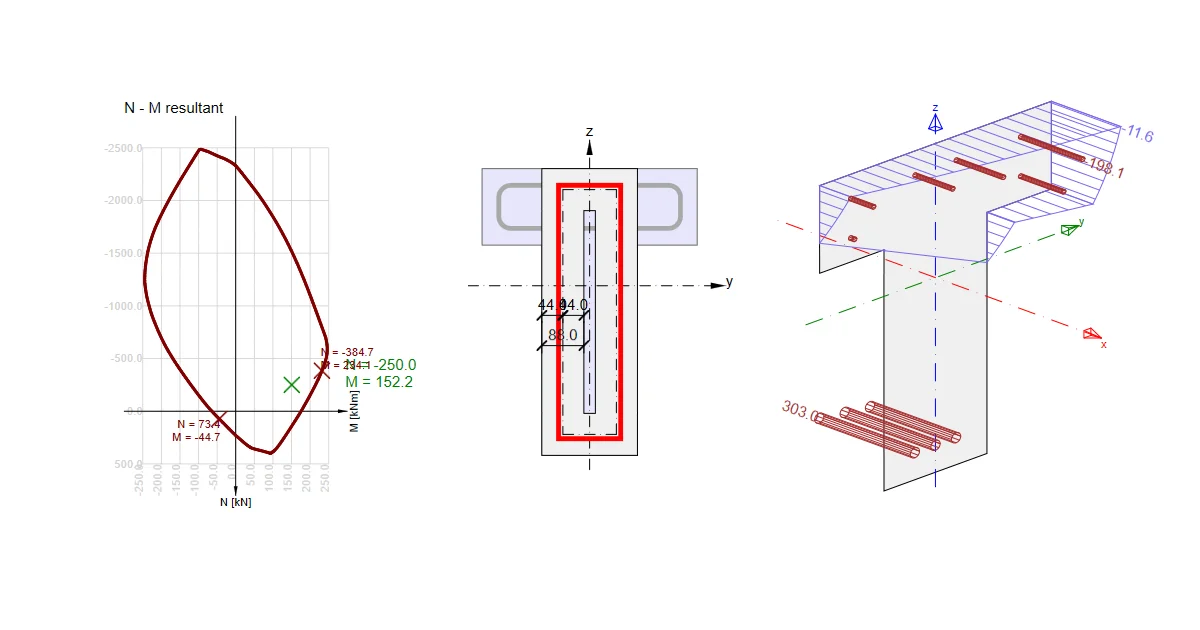
The most frequent usage of vestigial resistance is for prestressed members where is important to know the reserve to maximal capacity of the subjected member for the combination N+M+M.
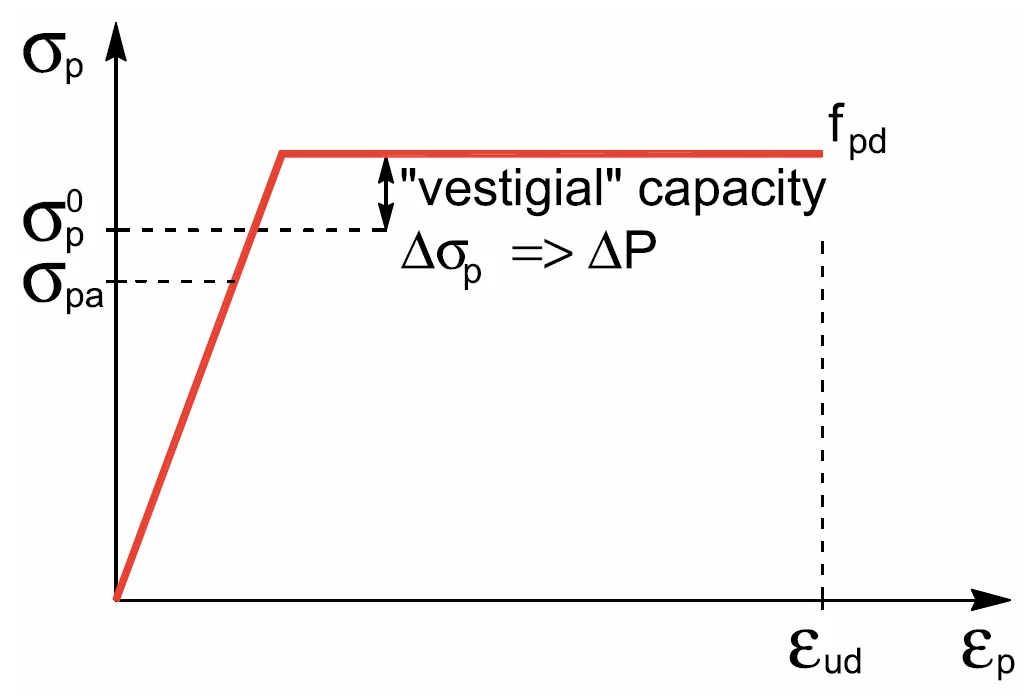
You can use the following inequation for axial force.

Vestigial resistance - external load and resistance

The left-hand side of the inequality contains the external load and the right-hand side of the resistance. Generally, the right-hand side then contains the primary effects resulting from the decompression prestressing force and the effects of the vestigial resistance of the prestressing reinforcement.

As a consequence of this, you cannot find prestressing force P on the side of outer loads in IDEA StatiCa. It' being seen in the following tab. 
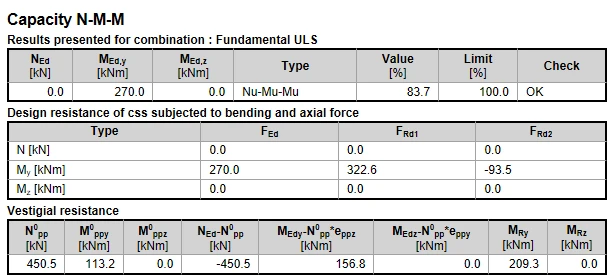
Capacity results

N0pp stands for primary force causing decompression stress in prestressed reinforcement

NEd stands for external load – in this case, the external load was equal to zero

Take the latest version of IDEA StatiCa for a test drive today

Get 14 days of full access, completely free.

Check out IDEA StatiCa for free

Related articles

Code and calculation settings in RCS
  • Concrete
  • RCS
  • EN (Eurocode)
  • +3
  • Concrete
  • RCS
  • EN (Eurocode)

Knowledge base

Code and calculation settings in RCS

Read more
ULS results in RCS - Capacity N-M-M, Shear, Torsion, Interaction, Response N-M-M
  • Concrete
  • RCS
  • EN (Eurocode)
  • ULS
  • +4
  • Concrete
  • RCS
  • EN (Eurocode)
  • ULS

Knowledge base

ULS results in RCS - Capacity N-M-M, Shear, Torsion, Interaction, Response N-M-M

Read more
Action stages - RCS, Initial state
  • Concrete
  • RCS
  • Prestressed members
  • Prestressing losses
  • EN (Eurocode)
  • Load effects
  • +6
  • Concrete
  • RCS
  • Prestressed members
  • Prestressing losses
  • EN (Eurocode)
  • Load effects

Knowledge base

RCS - Action stages

Read more