Idea Statica
  • Steel
  • Concrete
  • BIM & Workflows
  • Support & Learning
  • Pricing
  • Company
  • Steel overview
  • Connection design
  • Member design
  • Parametric design
  • Steel case studies
  • Concrete overview
  • Walls and D-regions
  • Anchoring design
  • Concrete case studies
  • BIM Overview
  • Supported integrations
  • Checkbot
  • Viewer
  • APIs
  • Support Center
  • E-learning & certification
  • Blog
  • Downloads & Licensing
  • Plans
  • Free community tool
  • Enterprise customers
  • Students & educators
  • How much will you save?
  • About us
  • Contact
  • Research & development
  • Authorized resellers
  • Meet our customers
  • Career
  • Steel
    Steel overviewConnection designMember designParametric designSteel case studies
  • Concrete
    Concrete overviewWalls and D-regionsAnchoring designConcrete case studies
  • BIM & Workflows
    BIM OverviewSupported integrationsCheckbotViewerAPIs
  • Support & Learning
    Support CenterE-learning & certificationBlogDownloads & Licensing
  • Pricing
    PlansFree community toolEnterprise customersStudents & educatorsHow much will you save?
  • Company
    About usContactResearch & developmentAuthorized resellersMeet our customersCareer
14-Day Trial
14-Day Trial
  • Steel
  • Concrete
  • BIM & Workflows
  • Support & Learning
  • Pricing
  • Company

Subscribe to our newsletter

Company

  • About us
  • Partners
  • Careers
  • Patent

Resources

  • Customer projects
  • Case studies
  • Connection Library
  • Verification books

Legal

  • EULA
  • Privacy policy
  • California Privacy
  • TOS Viewer
  • Licensing

Help

  • Contact
  • Quote request
  • Resellers
  • Downloads
FacebookInstagramLinkedInYouTube

ยฉ IDEA StatiCa 2009-2026

Trusted and used worldwide by engineers, fabricators & consultants.

Support CenterKnowledge Base ArticlesImplementation of long-term losses in Detail
Introduction and assumptions
Prestressing in Detail - Model description
Prestressing in Detail - Pre-tensioned strands
Prestressing in Detail - Post-tensioned tendons
Prestressing in Detail โ€“ unbonded tendons
Prestressing to ACI 318-19 in Detail
Self-weight for prestressed members in Detail
Structural design of prestressed discontinuity regions
Auto-calculation of short-term losses for post-tensioned tendons
SLS checks of prestressed concrete discontinuity regions
Implementation of long-term losses in Detail
Long-term losses in Detail
ConcretePrestressed concreteKnowledge baseDetail 2DPrestressed members

Implementation of long-term losses in Detail

This article is also available in
ENCZDEESFRITPTNLHUROKRPLTHTRVIZH

Every prestressed structure has to be checked at least at the beginning and end of its service life. That is the reason why we added the option to set the stress in the prestressing reinforcement at the end of its working life. Read the following article to learn how to do it.

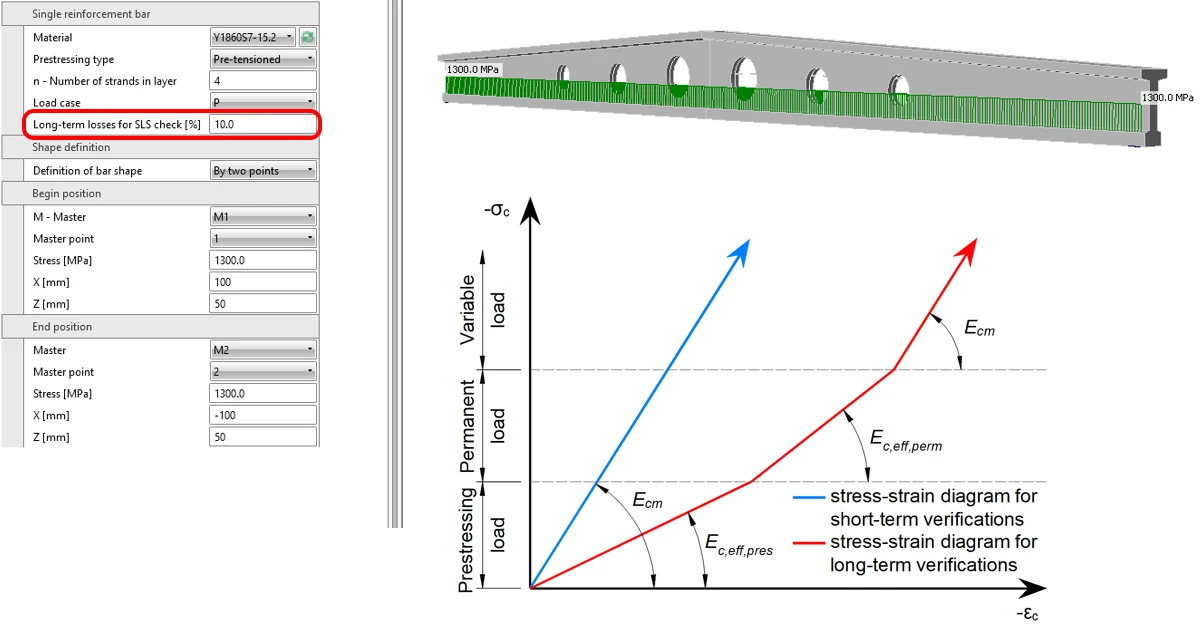
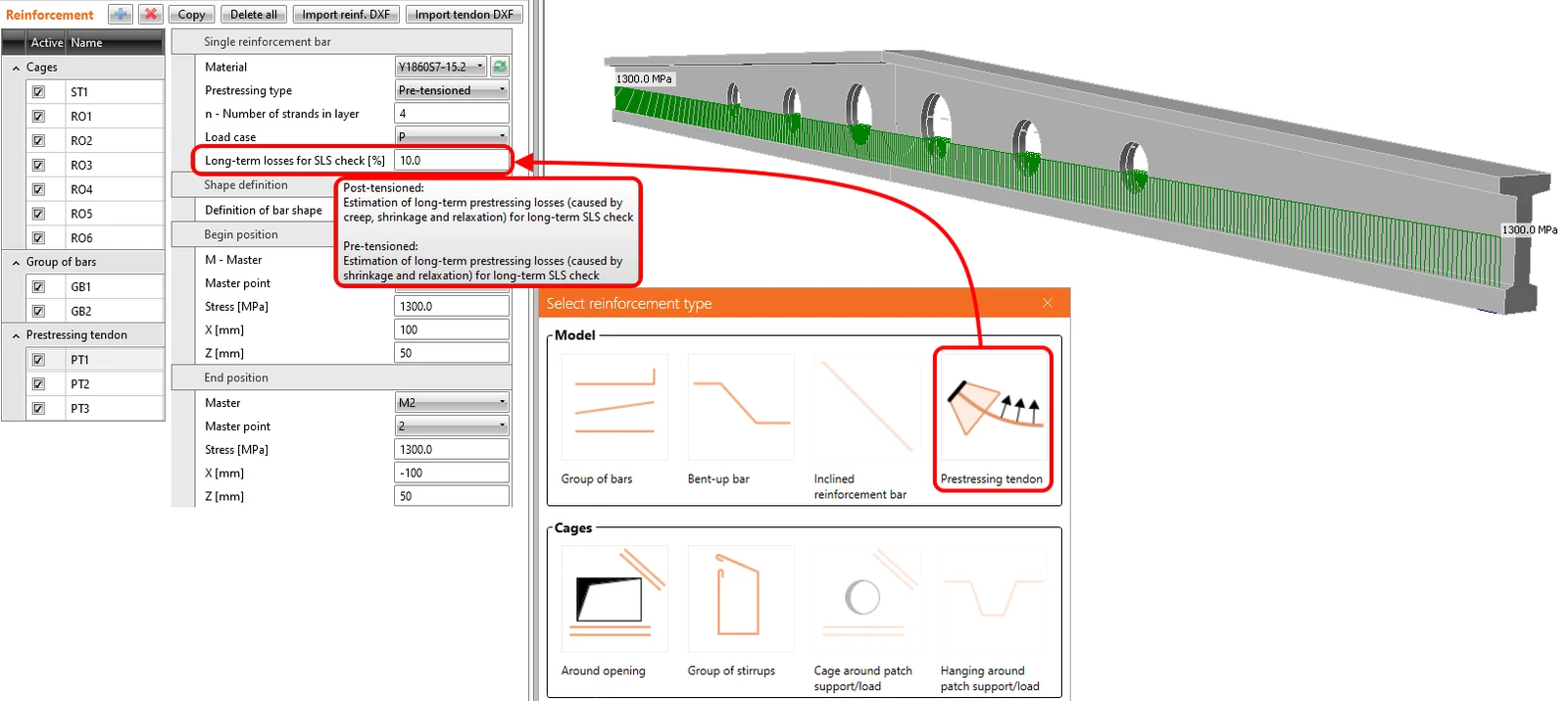
From version 23.0, you can set the estimation for long-term losses for pre-tensioned and post-tensioned tendons. It means that you won't have to complicatedly create special combinations with different prestressing coefficients to assess the structure at the beginning and end of its service life. A new entity in the properties of prestressing tendon called Long-term losses for SLS check [%] is now available, which allows you to check the short-term and long-term effects within one combination.
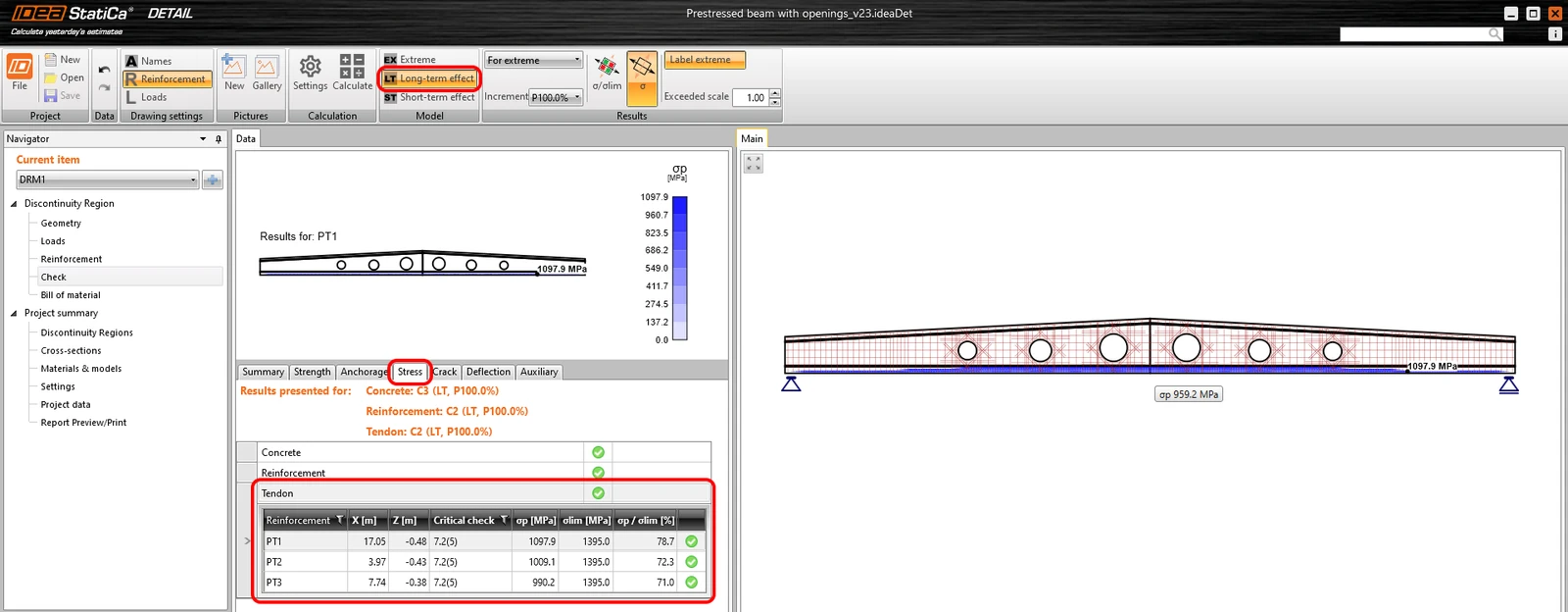
After calculation, you can switch between long-term and short-term to see the different results affected by the different material models as well as different initial stresses in the tendon.
How does it work? Read the following text to explore all the consequences of this new functionality.

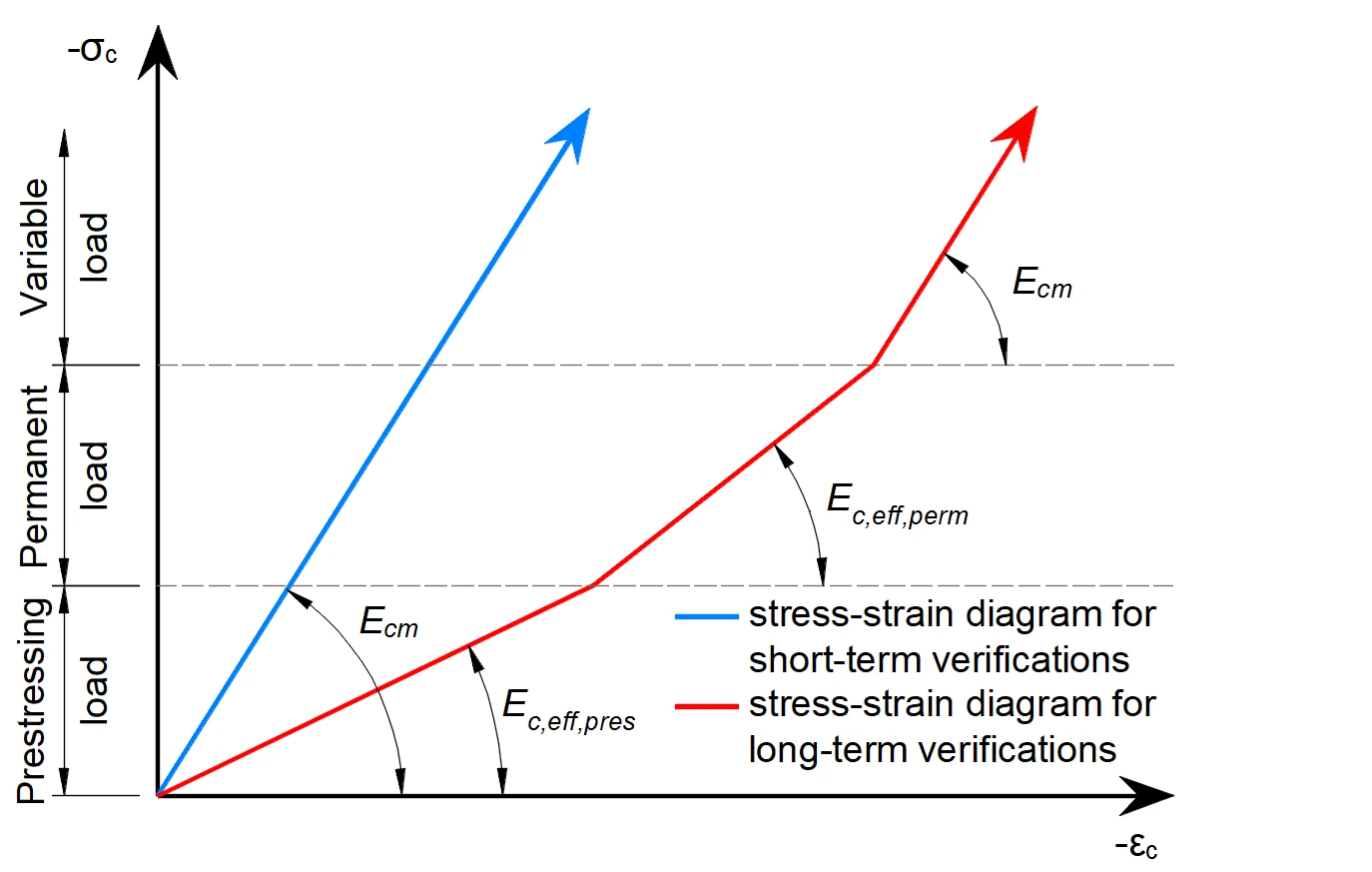
For the calculation of the long-term effect in SLS checks, the values of stresses in the prestressing reinforcement are reduced by the defined value of the long-term losses. In other words, reduced stress by the estimation of long-term losses is used for prestressing increment where the Ec,eff,press is used.ย 

The value of long-term losses for SLS check [%], which should be set for pre-tensioned and post-tensioned tendons, differs. Here's why.

Pre-tensioned tendons

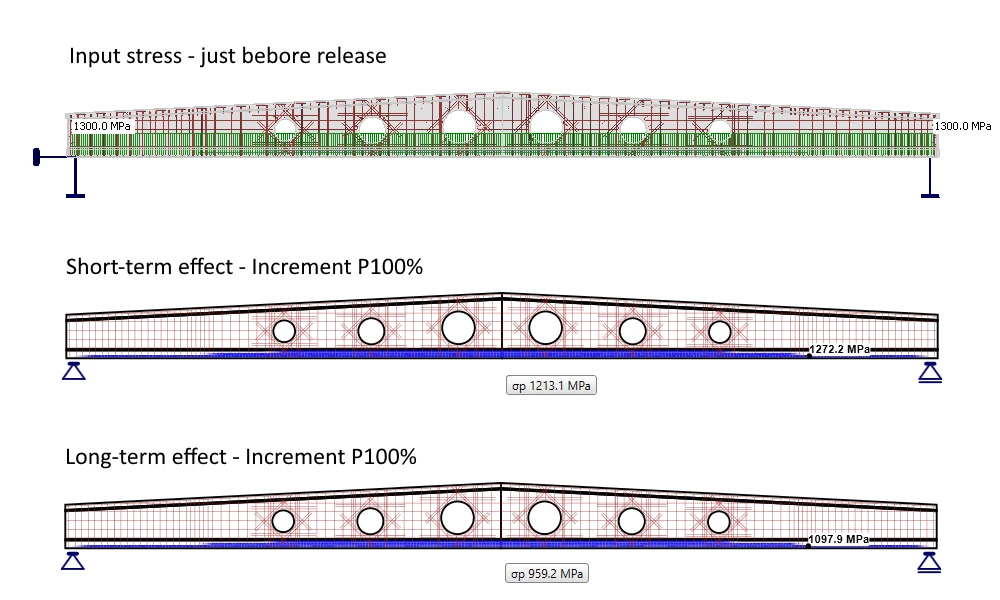
For pre-tensioned tendons, the input stress is the stress just before the release from abutments (stress after short-term losses due to anchorage set -> slip, deformation of abutments, short-term relaxation, etc.). The elastic strain in concrete is automatically calculated with the corresponding material model (Ecm is used for short-term effects, and Ec,eff,press is used for long-term effects). It follows that the long-term losses for the SLS check [%] is the value defining long-term losses caused byย shrinkage and long-term relaxation. The default value is 10%.

As you can see in the figure below, there are now three types of stress.

  • Input stress just before the release
  • Stress after short-term losses
  • Stress after long-term losses

Note that the self-weight is defined as a prestressing load type. The first increment (including self-weight) prestressing is shown.

Post-tensioned tendons

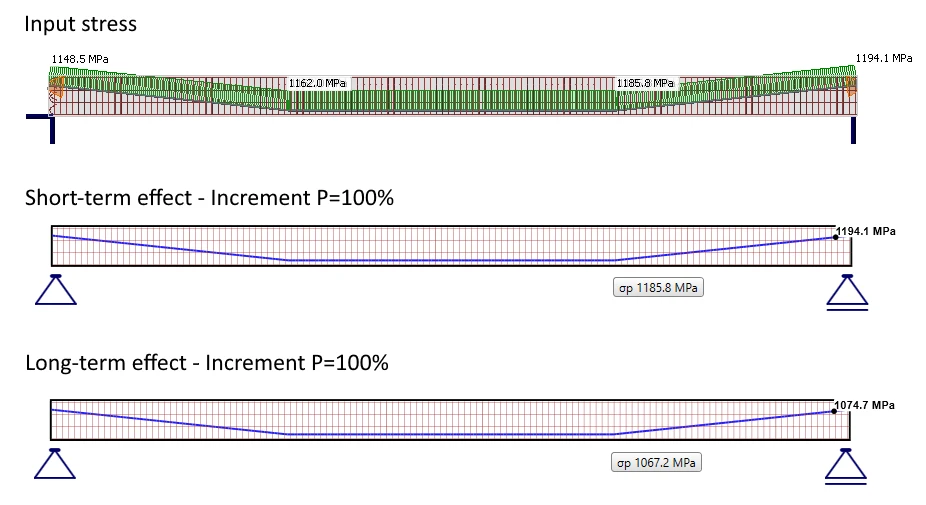
For post-tensioned tendons, the input stress is the stress after short-term losses, or you can set the anchorage stress and get the program to calculate the short-term losses automatically. Short-term losses, in this case, are โ€“ friction, immediate elastic strain in concrete, and anchorage set -> slip. It follows that the long-term losses for SLS check [%] is the value defining long-term losses caused byย creep, shrinkage, and long-term relaxation. The default value is 10%.

As you can see in the figure below, there are now two types of stress.ย 

  • Input stress = Stress after short-term losses
  • Stress after long-term losses

Note that the self-weight is defined as a prestressing load type. The first increment (including self-weight) prestressing is shown.

Available in Enhancedย editions ofย IDEA StatiCa Prestressing.

Download the new version of IDEA StatiCa and try all the features

Download new version

Related articles

Release notes IDEA StatiCa 23.0
  • Concrete
  • Steel
  • Connection
  • Detail 2D
  • Member
  • Checkbot
  • Viewer
  • RCS
  • IDEA Open Model (API)
  • ACI (USA)
  • AISC (USA)
  • BIM link
  • EN (Eurocode)
  • v23.0
  • +14
  • Concrete
  • Steel
  • Connection
  • Detail 2D
  • Member
  • Checkbot
  • Viewer
  • RCS
  • IDEA Open Model (API)
  • ACI (USA)
  • AISC (USA)
  • BIM link
  • EN (Eurocode)
  • v23.0

Release notes

Release notes IDEA StatiCa 23.0

Read more