Idea Statica
  • Steel
  • Concrete
  • BIM & Workflows
  • Support & Learning
  • Pricing
  • Company
  • Steel overview
  • Connection design
  • Member design
  • Parametric design
  • Steel case studies
  • Concrete overview
  • Walls and D-regions
  • Anchoring design
  • Concrete case studies
  • BIM Overview
  • Supported integrations
  • Checkbot
  • Viewer
  • APIs
  • Support Center
  • E-learning & certification
  • Blog
  • Downloads & Licensing
  • Plans
  • Free community tool
  • Enterprise customers
  • Students & educators
  • How much will you save?
  • About us
  • Contact
  • Research & development
  • Authorized resellers
  • Meet our customers
  • Career
  • Steel
    Steel overviewConnection designMember designParametric designSteel case studies
  • Concrete
    Concrete overviewWalls and D-regionsAnchoring designConcrete case studies
  • BIM & Workflows
    BIM OverviewSupported integrationsCheckbotViewerAPIs
  • Support & Learning
    Support CenterE-learning & certificationBlogDownloads & Licensing
  • Pricing
    PlansFree community toolEnterprise customersStudents & educatorsHow much will you save?
  • Company
    About usContactResearch & developmentAuthorized resellersMeet our customersCareer
14-Day Trial
14-Day Trial
  • Steel
  • Concrete
  • BIM & Workflows
  • Support & Learning
  • Pricing
  • Company

Subscribe to our newsletter

Company

  • About us
  • Partners
  • Careers
  • Patent

Resources

  • Customer projects
  • Case studies
  • Connection Library
  • Verification books

Legal

  • EULA
  • Privacy policy
  • California Privacy
  • TOS Viewer
  • Licensing

Help

  • Contact
  • Quote request
  • Resellers
  • Downloads
FacebookInstagramLinkedInYouTube

© IDEA StatiCa 2009-2026

Trusted and used worldwide by engineers, fabricators & consultants.

Support CenterKnowledge Base ArticlesHorizontal tying
Advanced analysis types for your steel structures
Horizontal tying
Horizontal tying resistance
SteelConnection designKnowledge baseEN (Eurocode)Connection

Horizontal tying

This article is also available in
ENCZDEESFRITPTNLHUROKRPLTHTRVIZH

Every larger building should be designed against accidental situations to prevent progressive collapse. Several options are possible but the most used is the prescriptive approach – horizontal tying.

Connections must be designed to transform tensile force that is generated by second-order effects – column is removed and the floor acts as a membrane.

Supports

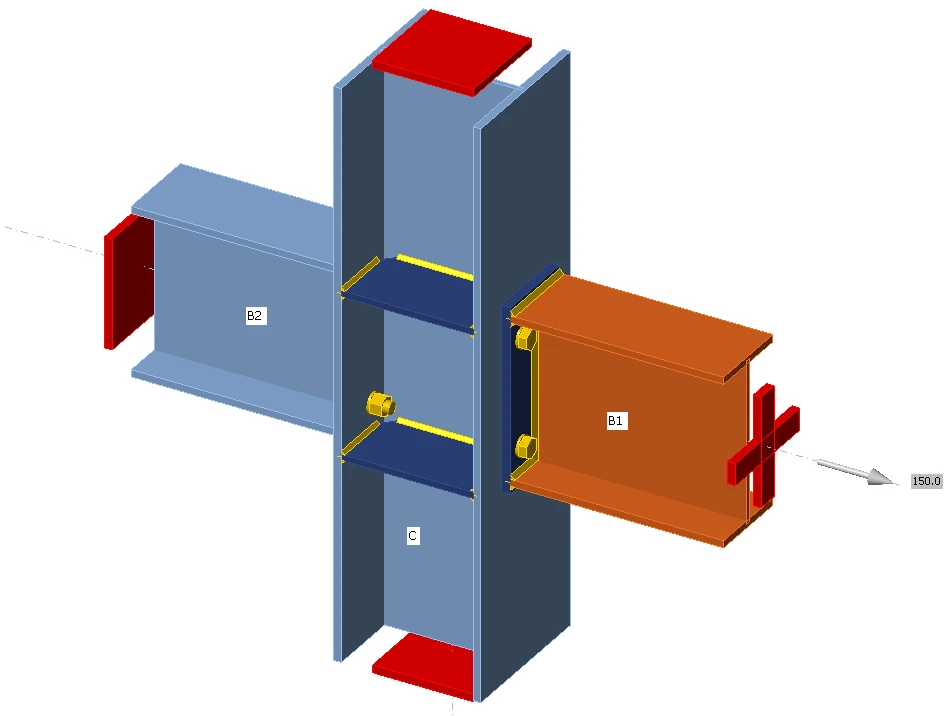
Only one member is analyzed and all other members are fixed at their ends. Only the normal force should be applied to the analyzed member, so its model type is set to N-Vy-Vz (bending moments and torsion are restricted).
Loading

Normal force acting on the analyzed member should be determined according to EN 1993-1-7, Cl. A.5.1:

For internal ties:

Ti=0.8(gk+ψqk)sL≥75 kNT_i=0.8(g_k+\psi q_k) s L \ge 75 \textrm{ kN}Ti​=0.8(gk​+ψqk​)sL≥75 kN

For perimeter ties:

Tp=0.4(gk+ψqk)sL≥75 kNT_p=0.4(g_k+\psi q_k) s L \ge 75 \textrm{ kN}Tp​=0.4(gk​+ψqk​)sL≥75 kN

where:

  • gkg_kgk​ – characteristic permanent loading
  • qkq_kqk​ – characteristic imposed loading
  • sss – spacing of ties
  • LLL – span of the tie
  • ψ\psiψ – relevant factor in the expression for a combination of action effects for the accidental design situation (i.e. ψ1\psi_1ψ1​ or ψ2\psi_2ψ2​ in accordance with expression (6.11b) of EN 1990).

Material model and checks

According to SCI P358: Joints in steel construction: Simple Joints to Eurocode 3 – Appendix A, the partial safety factor for horizontal tying is introduced, γMu\gamma_{Mu}γMu​ with default value 1.1 editable in Code setup. This safety factor is used for plates, bolts, and welds in horizontal tying analysis. 

Extreme loads and deformations are expected and the design of plates is based on the ultimate strength of plates, fuf_ufu​. That is why the material model for finite element analysis behaves elastically up to fu/γMuf_u / \gamma_{Mu}fu​/γMu​. The slope of the plastic branch is Young's modulus of elasticity E/1000E/1000E/1000. Check is performed for 5% plastic strain limit.

The resistances of bolts and welds are calculated with γMu\gamma_{Mu}γMu​ instead of γM2\gamma_{M2}γM2​. When using the default values of partial safety factors, the load resistances are higher by about 14 % than for the ultimate limit state.

Preloaded bolts are assumed to slip and they are checked as regular, snug-tight bolts.

References

EN 1993-1-7: Eurocode 1 – Actions on structures – Part 1-7: General actions – Accidental actions, CEN, 2006.

SCI P358: Joints in steel construction: Simple Joints to Eurocode 3
ECCS project FAILNOMORE workshops 

Related articles

IDEA StatiCa Connection – Structural design of steel connections
  • Steel
  • Connection
  • EN (Eurocode)
  • AISC (USA)
  • AS (Australia)
  • CSA (Canada)
  • IS (India)
  • GB (China)
  • HKG (Hong Kong)
  • SP 16 (Russia)
  • CBFEM
  • +11
  • Steel
  • Connection
  • EN (Eurocode)
  • AISC (USA)
  • AS (Australia)
  • CSA (Canada)
  • IS (India)
  • GB (China)
  • HKG (Hong Kong)
  • SP 16 (Russia)
  • CBFEM

Theoretical background

IDEA StatiCa Connection – Structural design of steel connections

Read more
Check of components according to EN (Eurocode)
  • Steel
  • CBFEM
  • Plates
  • Connection
  • EN (Eurocode)
  • +5
  • Steel
  • CBFEM
  • Plates
  • Connection
  • EN (Eurocode)

Theoretical background

Check of steel connection components (EN)

Read more
The Horizontal tying resistance analysis helps to make the structural design and code-check of steel connections with the tensile loads required by code and prevent the progressive collapse of the structure.
  • Steel
  • Connection
  • EN (Eurocode)
  • Horizontal tying
  • AISC (USA)
  • +5
  • Steel
  • Connection
  • EN (Eurocode)
  • Horizontal tying
  • AISC (USA)

Knowledge base

Horizontal tying resistance

Read more