Idea Statica
  • Steel
  • Concrete
  • BIM & Workflows
  • Support & Learning
  • Pricing
  • Company
  • Steel overview
  • Connection design
  • Member design
  • Parametric design
  • Steel case studies
  • Concrete overview
  • Walls and D-regions
  • Anchoring design
  • Concrete case studies
  • BIM Overview
  • Supported integrations
  • Checkbot
  • Viewer
  • APIs
  • Support Center
  • E-learning & certification
  • Blog
  • Downloads & Licensing
  • Plans
  • Free community tool
  • Enterprise customers
  • Students & educators
  • How much will you save?
  • About us
  • Contact
  • Research & development
  • Authorized resellers
  • Meet our customers
  • Career
  • Steel
    Steel overviewConnection designMember designParametric designSteel case studies
  • Concrete
    Concrete overviewWalls and D-regionsAnchoring designConcrete case studies
  • BIM & Workflows
    BIM OverviewSupported integrationsCheckbotViewerAPIs
  • Support & Learning
    Support CenterE-learning & certificationBlogDownloads & Licensing
  • Pricing
    PlansFree community toolEnterprise customersStudents & educatorsHow much will you save?
  • Company
    About usContactResearch & developmentAuthorized resellersMeet our customersCareer
14-Day Trial
14-Day Trial
  • Steel
  • Concrete
  • BIM & Workflows
  • Support & Learning
  • Pricing
  • Company

Subscribe to our newsletter

Company

  • About us
  • Partners
  • Careers
  • Patent

Resources

  • Customer projects
  • Case studies
  • Connection Library
  • Verification books

Legal

  • EULA
  • Privacy policy
  • California Privacy
  • TOS Viewer
  • Licensing

Help

  • Contact
  • Quote request
  • Resellers
  • Downloads
FacebookInstagramLinkedInYouTube

© IDEA StatiCa 2009-2026

Trusted and used worldwide by engineers, fabricators & consultants.

Support CenterKnowledge Base ArticlesBond strength for anchors in Detail 3D
IDEA StatiCa Detail – Structural design of concrete 3D discontinuities
Complete code-check of anchors and concrete block with IDEA StatiCa (EN)
Complete code-check of anchors and concrete block in Detail 3D (ACI)
Bond strength for anchors in Detail 3D
ConcreteReinforced concreteKnowledge baseDetail 3DEN (Eurocode)

Bond strength for anchors in Detail 3D

This article is also available in
ENCZDEESFRITPTNLHUROKRPLTHTRVIZH

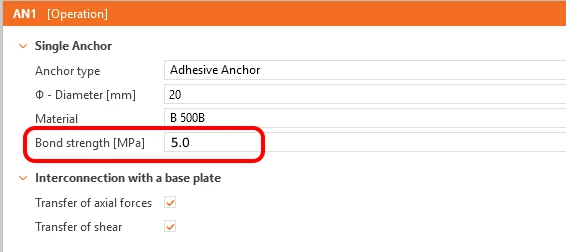
Where to find design bond strength needed as material parameter for post-installed anchors in 3D Detail? The following article demonstrates an example for Eurocode and ACI.

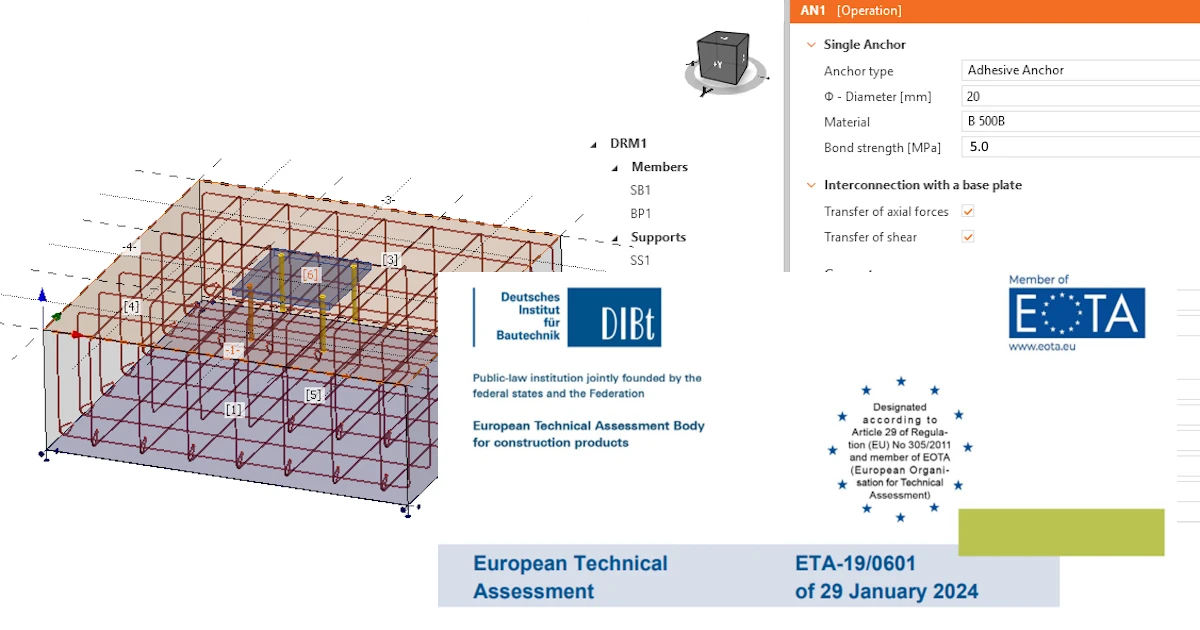
Bond strength property of a Single anchor in Detail 3D is the design value of bond resistance of Adhesive (post-installed) anchor. It is a crucial parameter for anchoring design in Detail 3D.
In terms of EN 1992-4, we can define design bond resistence as τRd = τRk /γMp 

γMp  is partial safety factor defined by table 4.1 in EN 1992-4

γMp = γMc = γc ⋅ γinst

γc = 1.5 for permanent and transient design situation

γc = 1.2 for accidental design s ituation

γinst  - factor accounting for the sensitivity to installation of post-installed fasteners. Can be found in relevant European Technical Product Specification for the specific product.

τRk  - is characteristic bond resistance of a post-installed bonded fastener. Depending on concrete strength class, and state of the concrete – cracked vs. uncracked. It can be found in certificate for injection mortar, for example ETA – European Technical Assesment.

Eurocode Example

Lets have post-installed bonded anchor made from M12 threaded bar and mortar Hilti HIT-HY 200-A V3. The hole is hammer-drilled. The anchor is installed in dry conditions into cracked C20/25 concrete. Design life is 50 years.

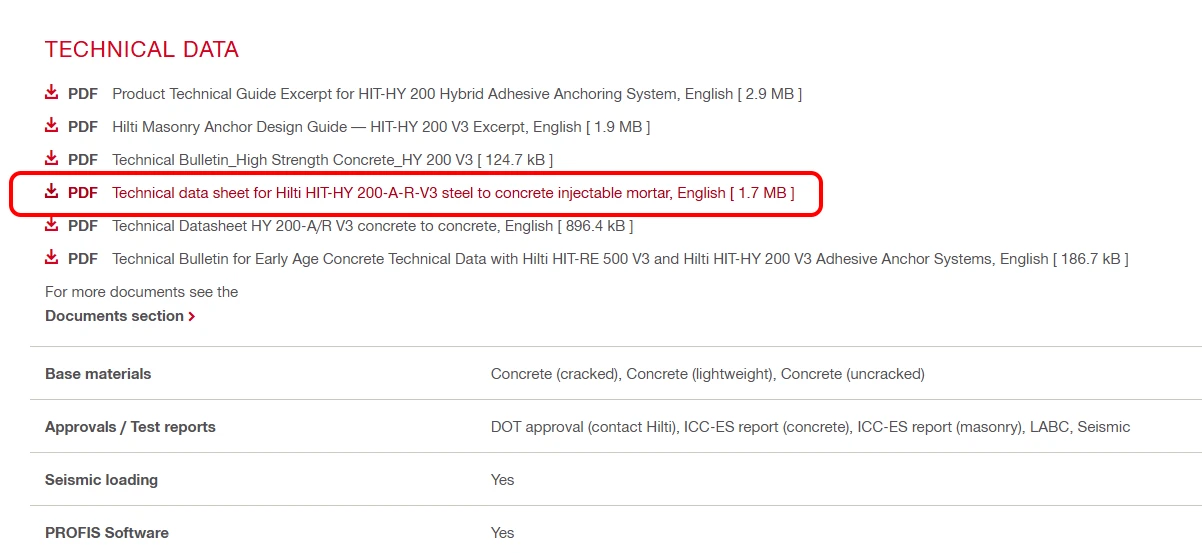
At first we need to go to HIT-HY 200-A product web page here. We are looking for ETA document. Go to Technical data section of the page and open PDF document Technical data sheet for Hilti HIT-HY 200-A-R-V3 steel to concrete injectable mortar, English.
On page 3 of the document, you can find links to relevant ETA documents.
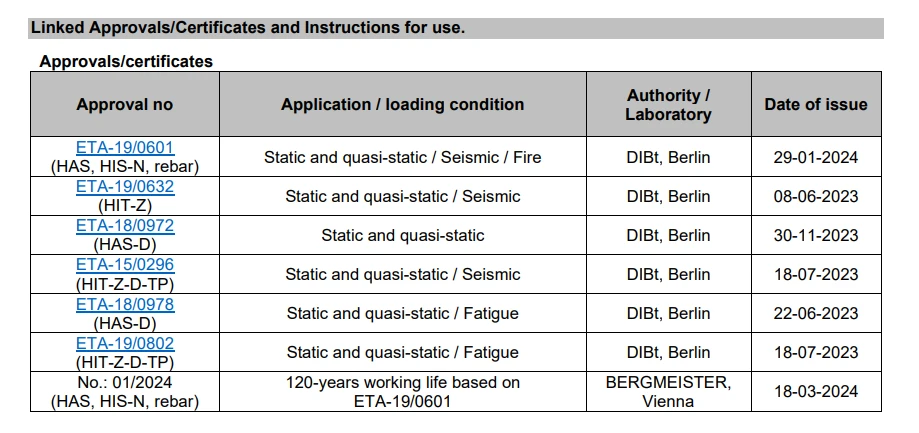
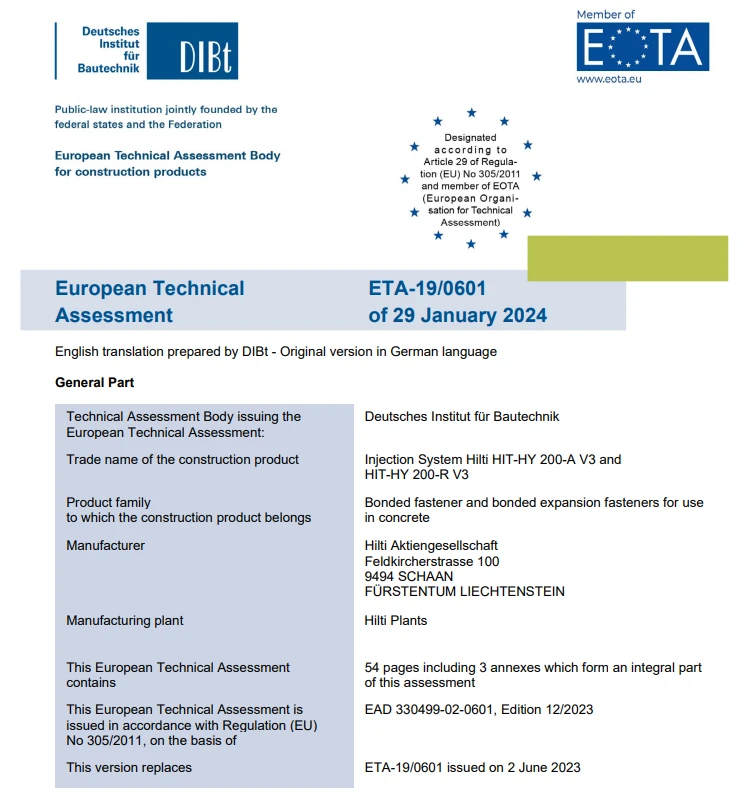
Open ETA-19/0601 linked in the first row of the table, which is relevant for us.
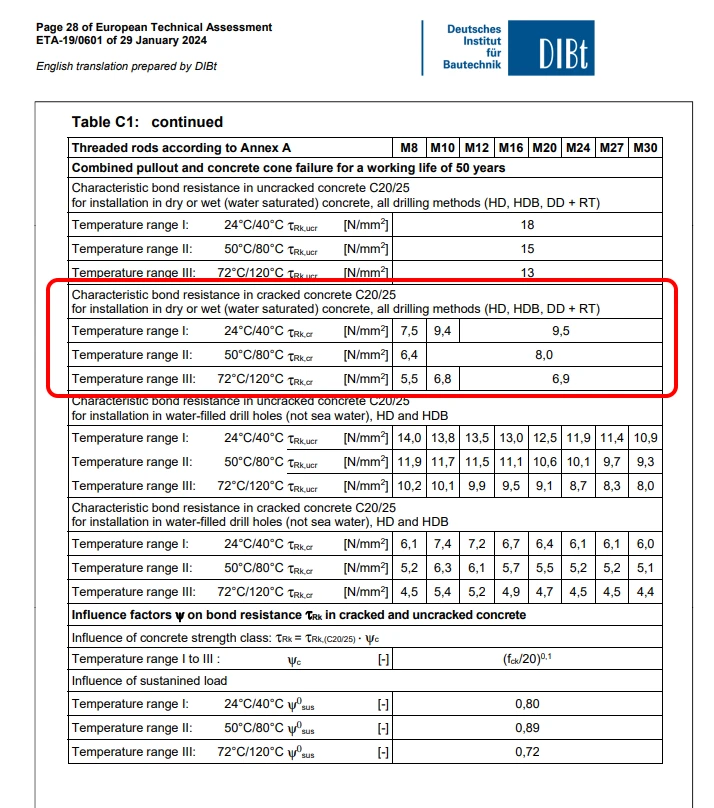
In table C1 of this document, you can find data for τRk - characteristic bond resistance. Conservatively for temperature range II, in our case τRk = 8.0 MPa.
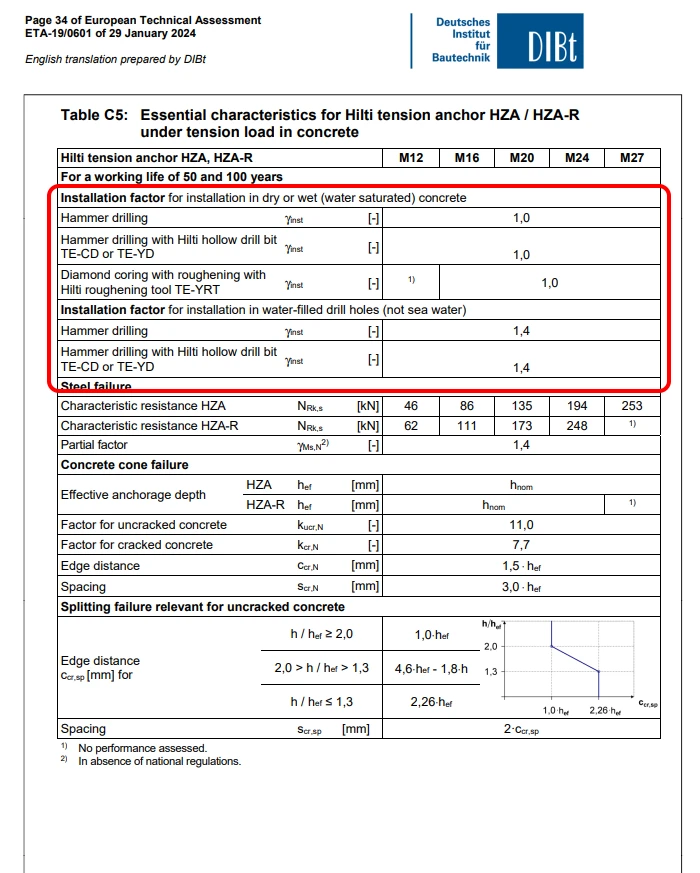
In table C1 of the document, you can also find relevant γinst values. In our case γinst = 1.0.
The final value of design bond strength is τRd = 8.0 /(1.5x1.0) = 5.3 MPa. 

ACI EXAMPLE

When using ACI, you can follow a similar process, for instance, Hilti HY200, go to their website. Find the product technical guide and open the PDF, The approvals are shown on the second page: 
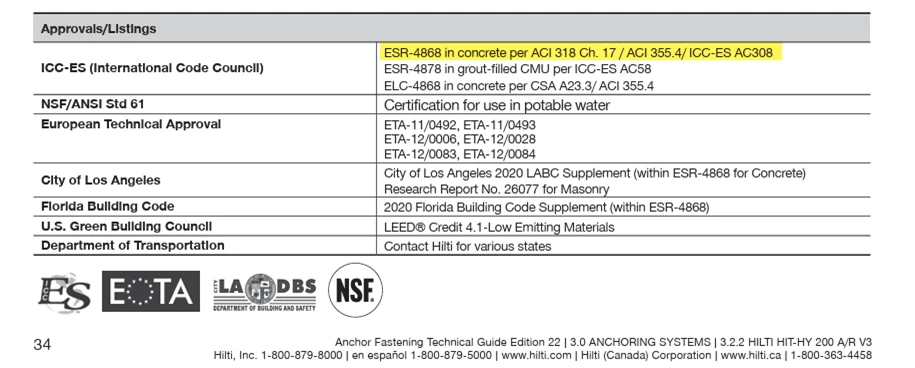
Then, we can open the selected ESR: https://icc-es.org/report-listing/esr-4868/

The bond strength tables are in the document. They are presented as a function of the concrete compressive strength, whether the concrete is cracked or uncracked, the concrete temperature range, and the installation conditions. 

The resulting characteristic bond strength shall be multiplied by the associated strength reduction factor, and the bond strength may also be made for increased concrete compressive strength as noted in the footnotes to the bond strength tables. 

Once you find the correct table, select the characteristic bond strength in cracked concrete, which is due to the principles of the Detail app, where the strength in tension is neglected. 

Table 13 Bond strength design information
  • τRk=840 psi
  • φd=0.65
  • Concrete increase factor for a f'c=4000 psi= 1.0481
  • IDEA StatiCa bond strength input = 0.65*1.0481*840psi= 572.26 psi

The bond strength should be input from technical data sheets; do not consider the values we have by default.

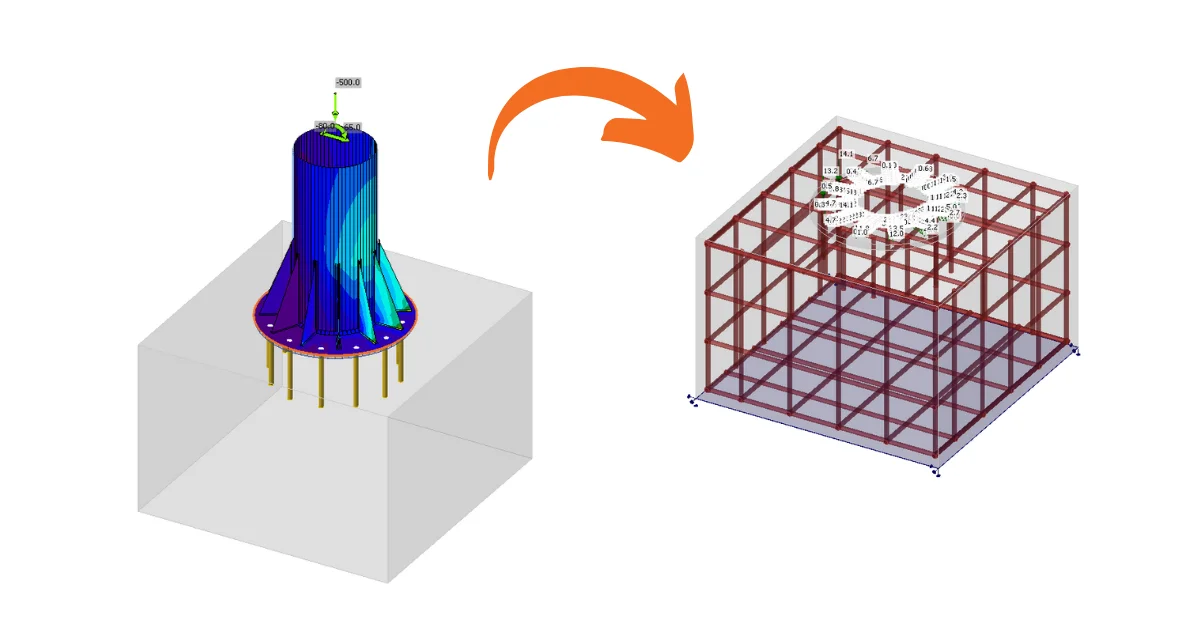
IDEA StatiCa 3D Detail is truly an anchoring must-have!
Insterested in 3D Anchoring?

TRY IT YOURSELF

Related articles

Import of anchoring from Connection to Detail
  • Concrete
  • Steel
  • Anchoring
  • Connection
  • Detail 3D
  • v24.0
  • v24.1
  • v26.0
  • +8
  • Concrete
  • Steel
  • Anchoring
  • Connection
  • Detail 3D
  • v24.0
  • v24.1
  • v26.0

Knowledge base

Import of anchoring from Connection to Detail

Read more
IDEA StatiCa Detail is concrete design software for the structural design and code-check of concrete discontinuity regions in 3D space. Concrete members stress analysis & concrete wall design.
  • Concrete
  • EN (Eurocode)
  • CSFM
  • ULS
  • Geometry
  • Load effects
  • Overall check
  • Material settings
  • Limitations
  • Support
  • Corbels/Brackets
  • Reinforcement
  • Shear
  • Stress in reinforcement
  • Detail 3D
  • +15
  • Concrete
  • EN (Eurocode)
  • CSFM
  • ULS
  • Geometry
  • Load effects
  • Overall check
  • Material settings
  • Limitations
  • Support
  • Corbels/Brackets
  • Reinforcement
  • Shear
  • Stress in reinforcement
  • Detail 3D

Theoretical background

IDEA StatiCa Detail – Structural design of concrete 3D discontinuities

Read more
3D Detail out of Beta
  • Concrete
  • v24.1
  • EN (Eurocode)
  • Detail 3D
  • +4
  • Concrete
  • v24.1
  • EN (Eurocode)
  • Detail 3D

Knowledge base

3D Detail out of Beta

Read more
Complete code-check of anchors and concrete block with IDEA StatiCa (EN)
  • Concrete
  • Detail 3D
  • Anchoring
  • Connection
  • EN (Eurocode)
  • +5
  • Concrete
  • Detail 3D
  • Anchoring
  • Connection
  • EN (Eurocode)

Knowledge base

Complete code-check of anchors and concrete block with IDEA StatiCa (EN)

Read more