


Many mid-20th-century designs used smooth rebars, whose bond behavior is significantly weaker than ribbed bars. Since design codes (EN, ACI, AS) are primarily based on ribbed reinforcement, this difference affects anchorage length, crack spacing, and stiffness modeling. With IDEA StatiCa Detail, it is possible accurately model and verify structures with smooth rebars, improving the reliability of crack width calculations and anchorage checks. This makes Detail a reliable tool for retrofitting and assessing older buildings, bridges, and precast elements.
The option is available for all implemented codes.
Switching the reinforcement type is possible in the Material Tab, where you can choose between two options: Ribbed to Smooth.
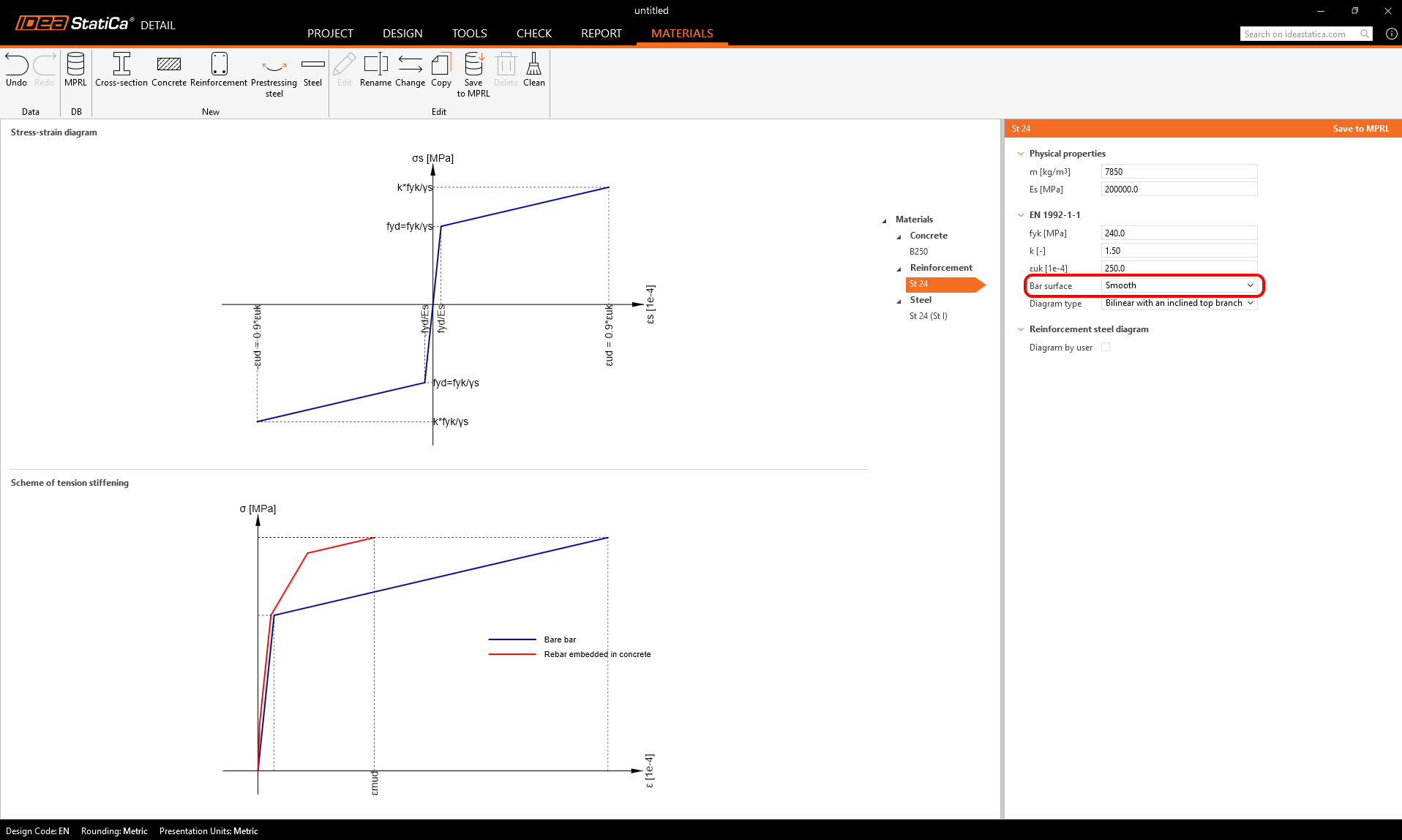
Reduction factors
For ACI and AUS, the reduction factors for bond and anchorage length follow code definitions; for EN, values are inspired by fib Model Code 2010 but can be adjusted by the user.
For consistency, the same reduction applied to bond strength in each design code is also used to scale the anchorage coefficient β in the CSFM (Compatible Stress Field Method) model. This ensures that the anchorage types, straight bar, hook, loop, etc., are correctly adjusted when smooth rebars are selected.
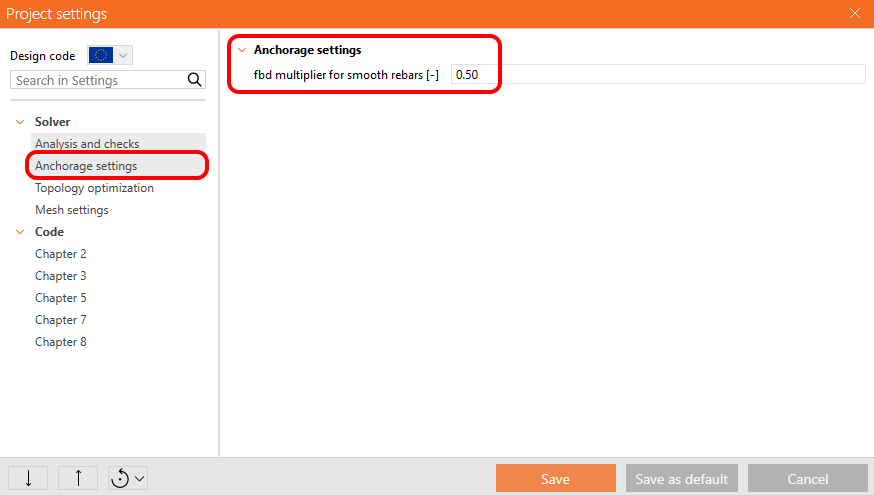
Code-specific adjustments for smooth rebars
- EN 1992-1-1: Eurocode 2 does not explicitly cover smooth reinforcement in terms of bond strength (EN 1992-1-1:2004, CL. 8.4.2). For crack spacing calculation (CL. 7.3.4), the code implicitly assumes ribbed reinforcement. Based on research, other codes, and guidance from fib Model Code 2010 (CL. 6.1, Table 6.1-2), this is implemented as a user-defined multiplier “fbd multiplier for smooth rebars,” defaulting to 0.5.
- ACI 318-19: Current ACI 318 (CL. 25.4.2.1) addresses development length only for deformed bars. Historical provisions in ACI 318-63 (§1402) specify that the required development length for plain (smooth) bars is twice that of deformed bars. Accordingly, Detail adopts a 0.5 bond reduction factor, consistent with this long-standing definition.
- AS 3600:2018: Clause C13.1.3 explicitly defines the development length for plain (smooth) bars as 1.5 Lsy,t, compared to Lsy,t for deformed bars. This corresponds to a bond reduction factor of 0.67, which is directly applied in anchorage and crack spacing checks.
The Tension chord model and Pull-out model were updated to reflect the reduced bond and different crack development of smooth rebars. For more information on the models, see the Theoretical Background.