
Idea Statica
Steel
Concrete
BIM & Workflows
Support & Learning
Pricing
Company
14-Day Trial
Support CenterKnowledge BaseSteel connection capacity design
Advanced analysis types for your steel structures
Seismic analysis in IDEA StatiCa Connection
Qualification checks of seismic prequalified connections for AISC
Prequalified Steel Connections (AISC) - Summary, Conclusion, and Recommendations
Steel connection capacity design
Capacity design (AISC)
Capacity design according to Canadian standards
The objective of capacity design is to confirm a building undergoes controlled ductile behavior in order to avoid a collapse in a design-level earthquake. Structural design of welded and bolted connections.
SteelConnection designKnowledge baseConnectionAISC (USA)

Steel connection capacity design

This article is also available in
ENCSDEESFRITPTNLHURO

Capacity design is a part of a joint check-in seismic design. When relying on the ductility of a structure, the capacity design must be performed. 

The objective of capacity design is to confirm a building undergoes controlled ductile behavior to avoid a collapse in a design-level earthquake.

A dissipative item is selected with increased strength and a modified material diagram. An overstrength factor \(\gamma_{ov}\) is defined in Materials, and a strain-hardening factor \(\gamma_{sh}\) at the dissipative item operation. Note that the nomenclature differs between the codes. A dissipative item is excluded from the strain check of plates. 
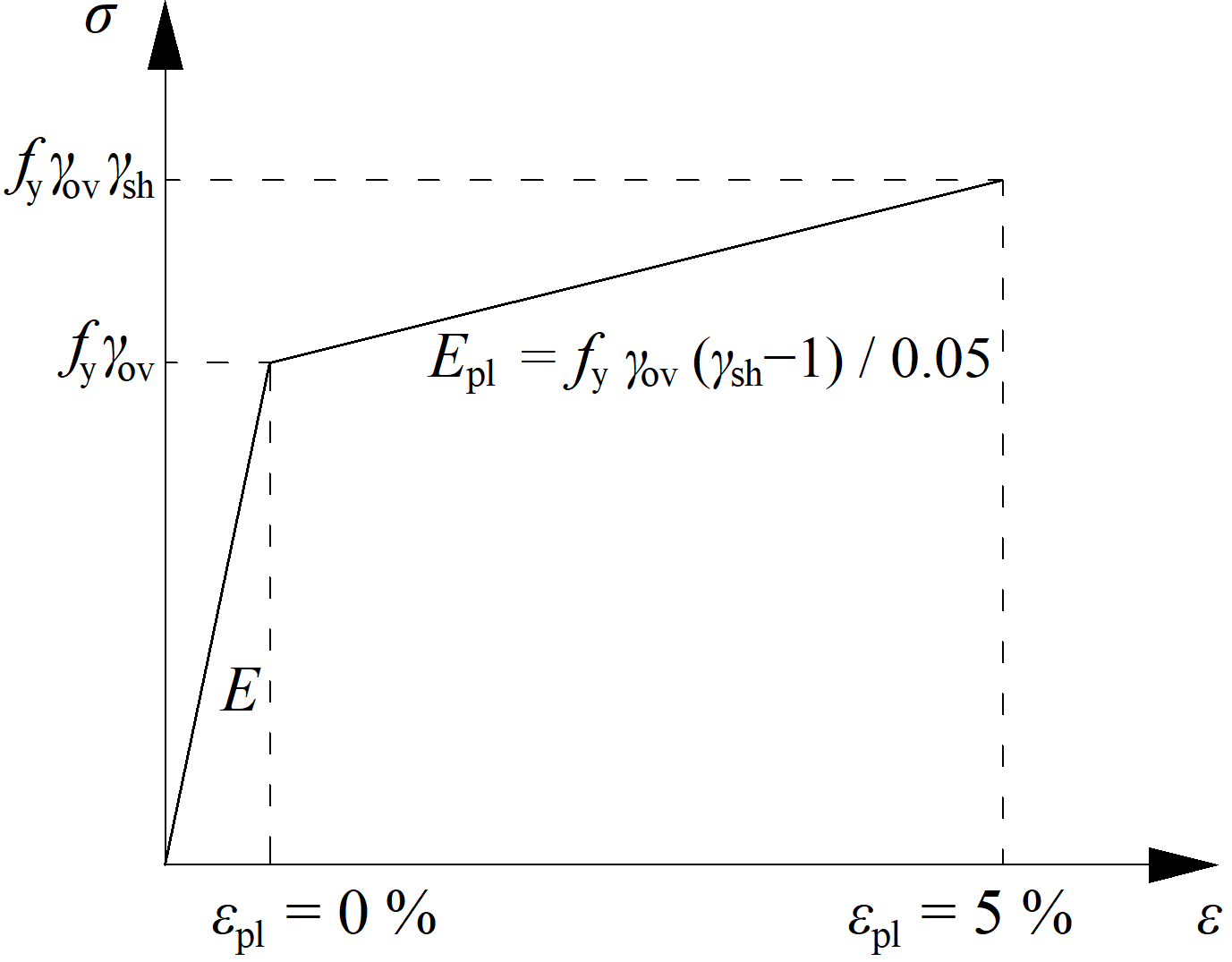
The objective of capacity design is to confirm a building undergoes controlled ductile behavior in order to avoid a collapse in a design-level earthquake. Structural design of welded and bolted connections.

Modified material diagram for dissipative item

IDEA StatiCa Connection checks the connection on applied design load, which should create a plastic hinge in the selected dissipative item, usually the beam. The plastic strain in the dissipative item should be around 5%. This can serve as a confirmation that the magnitude and position of loads were determined properly. 
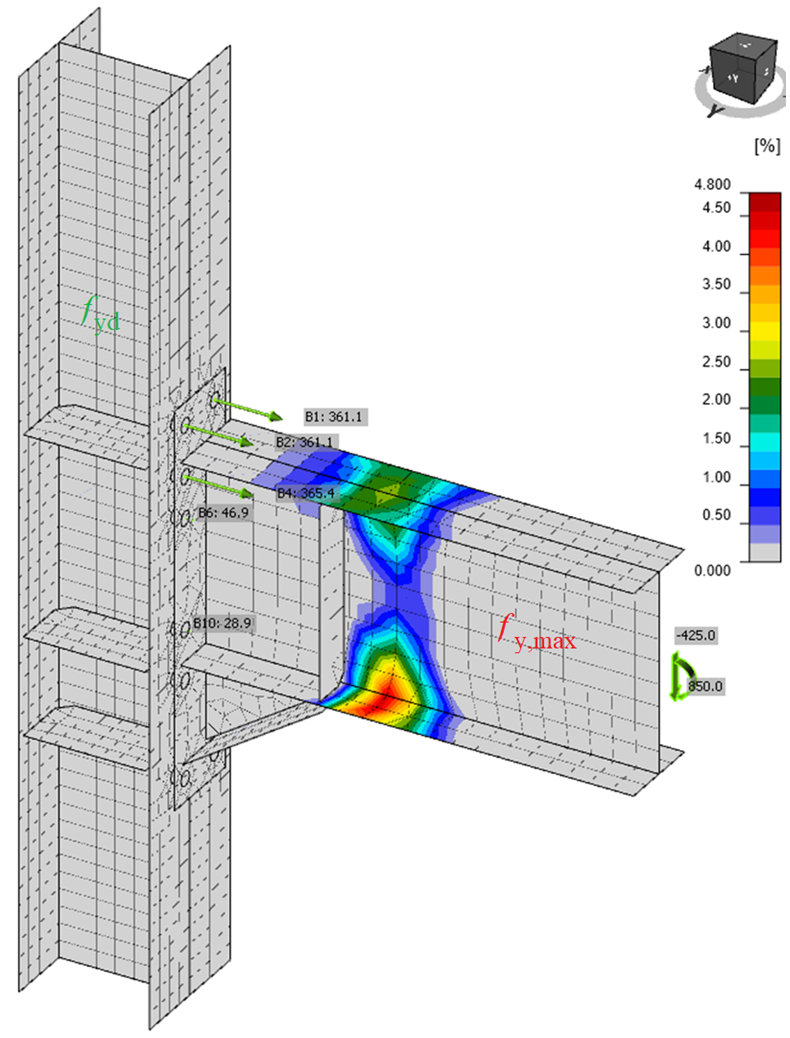
Plastic hinge

Plastic hinge created at the intended place of the dissipative item – the beam

The supports of the continuous member are automatically defined as supported at one end and with restrained moments at the other end. This way, the continuous column may be loaded by the normal force and shear forces, and also one side may move sideways so that the failure of the column web in shear is revealed.

Note, that detailing is very important for seismic resistant joints but is not checked in IDEA StatiCa. 

Subscribe to our newsletter

Company

  • About us
  • Partnerships
  • Job openings
  • Patented technology for structural engineers

Resources

  • Customer projects
  • Case studies
  • IDEA StatiCa Connection Library
  • Concrete verifications

Legal

  • IDEA StatiCa END USER LICENSE AGREEMENT
  • Privacy policy
  • Terms of Services – IDEA StatiCa Viewer
  • Licensing

Help

  • Contact
  • Get price quote
  • IDEA StatiCa Specialists
  • Download the latest version
FacebookInstagramLinkedInYouTube

© IDEA StatiCa 2009-2026

Trusted and used worldwide by engineers, fabricators & consultants.