


Quick Links
- Watch the webinar recording
- Download project example models
- Review the theoretical background
- Explore tutorials to go from design to code-check
- See a case study using ACI visualization
Review the resources below to see how bridge engineers can use IDEA StatiCa Detail to design, verify, and optimize reinforced concrete bridge components using AASHTO workflows.
Learn
Detail Theoretical Background (AASHTO Code)
Learn how IDEA StatiCa Detail applies AASHTO LRFD-based material models for reinforced concrete strength and serviceability analysis. This article covers the theoretical background behind concrete compression behavior, cracking effects, creep, reinforcement modeling, and tension stiffening used in the CSFM approach.
Read the full theoretical support article →
Tutorials: Cantilever Bent Cap
Learn how to use IDEA StatiCa Detail to model and code-check reinforced concrete discontinuity regions through a cantilever bent cap example built from scratch. Based on the FHWA Strut-and-Tie Modeling Design Examples (NHI 17-071), this tutorial demonstrates step-by-step how engineers can analyze complex D-region behavior, evaluate code-check results, and generate detailed reports using the Compatible Stress Field Method (CSFM).
Concrete Bridge Design with AASHTO Using Detail
With the implementation of AASHTO LRFD Bridge Design Specifications into IDEA StatiCa Detail 2D and 3D, structural engineers can now design and verify transportation infrastructure projects such as bridges, rail structures, foundations, and highway components within a unified analysis environment.
Using the Compatible Stress Field Method (CSFM), the software enables engineers to analyze complex discontinuity regions (D-regions) where traditional beam theory does not apply, while visualizing real stress flow, deflections, crack widths, and reinforcement behavior. IDEA StatiCa also incorporates AASHTO-specific material models, resistance factors, and serviceability checks, helping engineers perform more efficient and optimized code-compliant designs compared to traditional strut-and-tie approaches.
Download and Design
Detail 2D Files
Download the project files to begin designing and analyzing your own models in IDEA StatiCa. Open the moment frame model as either a wall or beam configuration to jump-start your workflow and explore how each behaves within the application. You can also download the complete zipped package to access both moment frame models, review the bill of materials, examine drawing documentation, and explore the full project report for a more comprehensive view of the project deliverables.
Webinar: Bridge & Infrastructure Design Concrete Workflow with AASHTO
This webinar highlights the latest features and enhancements introduced in the newest release of IDEA StatiCa with an overview of tools designed to improve efficiency and analysis capabilities across steel and concrete applications. Key updates include:
- Implementation of the AASHTO concrete code for bridge, transportation, and infrastructure projects
- Utilization ratio prediction for steel connections
- Upgraded 3D Scene in Checkbot
The session also explores new capabilities in Detail 3D, including anchor checks, failing member explanations, surface support reactions, and streamlined model updates directly from the Connection app.
Validate
ACI Verification Study: Reinforced Concrete Members with Discontinuities
Explore verification studies demonstrating how the Compatible Stress Field Method (CSFM) can be used to analyze reinforced concrete members with discontinuities where traditional Strut-and-Tie methods may be limited. Backed by research from The Ohio State University, these studies compare CSFM results against experimental data, ACI 318-19, AASHTO LRFD, traditional STM approaches, and ABAQUS finite element analysis.
The collection includes deep beams, walking columns, shear walls with openings, and corbels, with results showing strong correlation to experimental behavior and code-based design methods.
Review the full verification studies →
Knowledge Base: Getting Started with IDEA StatiCa Detail
Browse practical knowledge base articles covering the IDEA StatiCa Detail interface, navigation tools, general settings, materials management, view options, search functionality, and productivity features such as keyboard shortcuts. These resources are designed to help users quickly become familiar with the Detail application workflow and user environment.
Explore the Detail App knowledge base articles →
See Real Projects
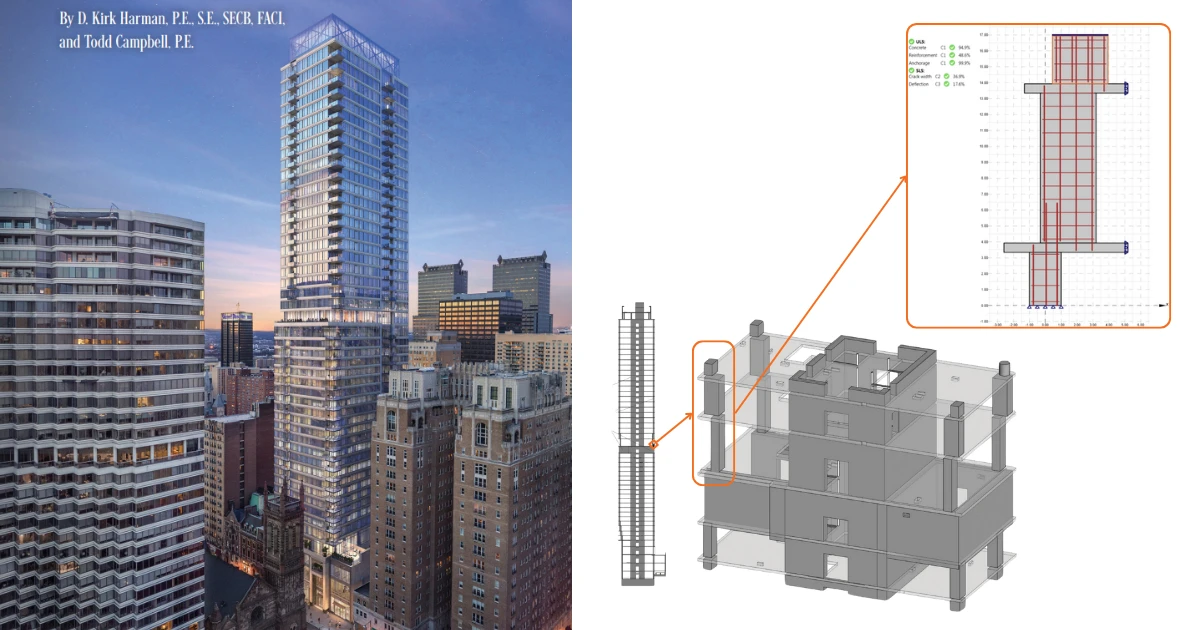
Walking columns present a unique structural engineering challenge because they gradually shift loads horizontally between floors rather than transferring them directly downward through aligned columns. On high-profile projects like The Laurel Rittenhouse Square in Philadelphia, IMEG used walking columns to preserve a historic three-story building while supporting more than 40 stories above.
Because no established ACI 318 methodology exists specifically for walking columns, engineers must rely on advanced analysis methods, engineering judgment, and strut-and-tie principles to evaluate these complex discontinuity regions. Using IDEA StatiCa Detail, IMEG was able to analyze load transfer, stress distribution, and reinforcement demands with greater precision, helping validate design assumptions and improve confidence in the final structural solution.
Review the case study: The Laurel Rittenhouse Square Project →
Other References
"Design of Complex Bridge Substructure Using the Strut-and-Tie Method" https://ascelibrary.org/doi/10.1061/9780784486924.010