Idea Statica
  • Steel
  • Concrete
  • Support & Learning
  • Pricing
  • Company
  • Steel overview
  • Connection design
  • Member design
  • Parametric design
  • Steel case studies
  • Concrete overview
  • Walls and D-regions
  • Anchoring design
  • Concrete case studies
  • BIM Overview
  • Supported integrations
  • Checkbot
  • Viewer
  • APIs
  • Support Center
  • E-learning & certification
  • Blog
  • Downloads & Licensing
  • Plans
  • Free community tool
  • Enterprise customers
  • Students & educators
  • How much will you save?
  • About us
  • Contact
  • Research & development
  • Authorized resellers
  • Meet our customers
  • Career
  • Steel
    Steel overviewConnection designMember designParametric designSteel case studies
  • Concrete
    Concrete overviewWalls and D-regionsAnchoring designConcrete case studies
  • BIM OverviewSupported integrationsCheckbotViewerAPIs
  • Support & Learning
    Support CenterE-learning & certificationBlogDownloads & Licensing
  • Pricing
    PlansFree community toolEnterprise customersStudents & educatorsHow much will you save?
  • Company
    About usContactResearch & developmentAuthorized resellersMeet our customersCareer
14-Day Trial
14-Day Trial

Subscribe to our newsletter

Company

  • About us
  • Partners
  • Careers
  • Patent

Resources

  • Customer projects
  • Case studies
  • Connection Library
  • Verification books

Legal

  • EULA
  • Privacy policy
  • California Privacy
  • TOS Viewer
  • Licensing

Help

  • Contact
  • Quote request
  • Resellers
  • Downloads
FacebookInstagramLinkedInYouTube

ยฉ IDEA StatiCa 2009-2026

Trusted and used worldwide by engineers, fabricators & consultants.

Sizing a deep beam for an industrial construction project
Concrete

Sizing a deep beam for an industrial construction project

Germany

Challenge:

Deep beams pose a particular challenge in structural engineering due to their low slenderness ratio and the associated complex load-bearing mechanisms. Load transfer occurs primarily through a system of compression struts in the concrete and tension ties in the reinforcement.

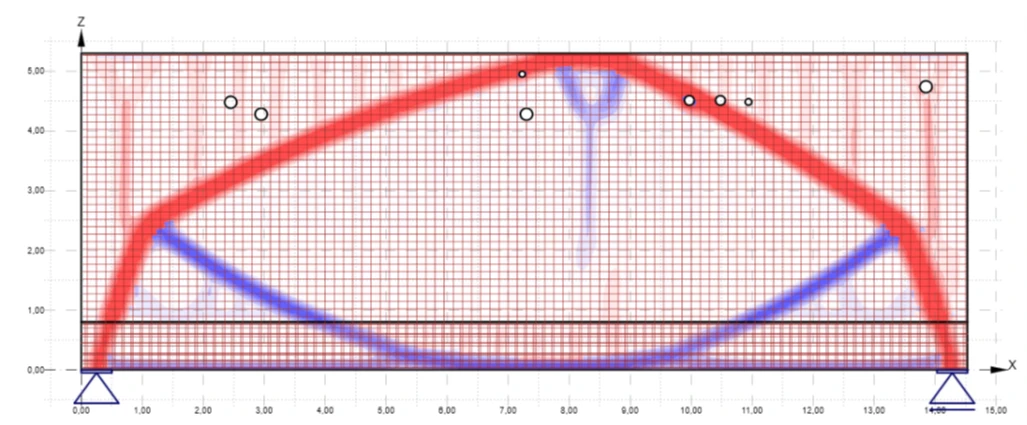
To transfer the loads from two upper floors, a deep beam with a span of 16 m had to be designed. The IDEA StatiCa Detail software was used for the structural analysis.ย 

As planning progressed, additional openings in the deep beam became necessary. To investigate the load-bearing behavior of the beam with regard to the D-regions, a load-bearing capacity analysis was performed using the finite element method (FEM) or FE-based stress field analysis method (CSFM), based on nonlinear material behavior.

A nonlinear calculation was performed taking into account the existing reinforcing steel.

Concrete stresses in the SLS:

The results of the FE calculation showed a local exceedance of concrete stresses in the SLS for a 100 mm opening. Since these are local stress peaks and there are sufficiently underutilized areas in the surrounding region, the stresses can redistribute through plasticization of the concrete. Furthermore, there is sufficient reinforcing steel in the surrounding area.

Conclusion:

The CSFM analysis performed using IDEA StatiCa demonstrated that the existing reinforcement ensures proper load distribution across the new openings.